“In Falling Timbers Buried”

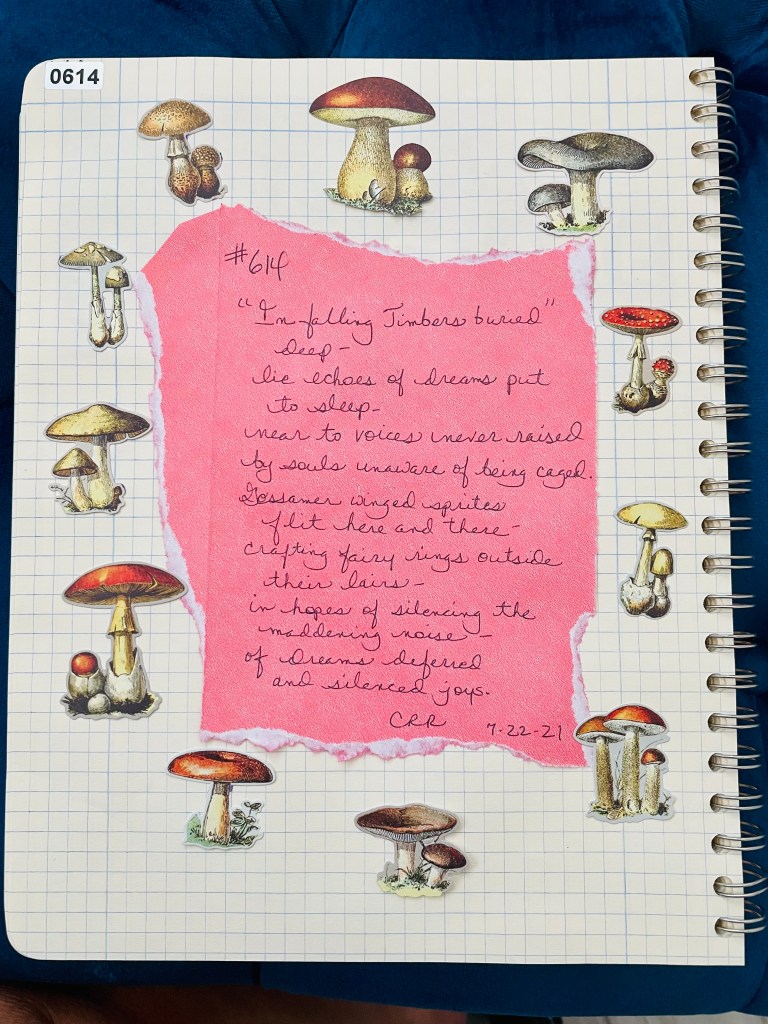
Some say Emily Dickinson had a morbid fascination with death. Others see the fact that approximately 1/6th of all her poems and letters were about death as something not unusual for one who lived next to a cemetery and during a time when folks died of illnesses at a much younger age than we do today. Her poem #614 speaks of diggers attempting to find a man buried in rubble. Too late, the saving grace is Death, in that he is no longer suffering.

I saw the setting of the first line of #614 as a place where dreams die, aspirations are quashed and we sometimes don’t even understand that we have made ourselves prisoners. I imagined a frolic of mythical forest fairies engaging in a battle with death, attempting to coax it into and ward it off with their fairy ring of mushrooms, a place of legendary doom for non-fairy folk.

In researching fairy rings, I learned quite a bit and will definitely be on the lookout for them in the future. If there’s a full moon and you see me running around one nine times, from east to west (the direction of the sun), it will be in hopes of hearing the fairies dancing and frolicking underground. Please just watch from afar and don’t make me lose count, for legend has it if I run around a tenth time I will meet ill fate and be made to run to the point of exhaustion and death and/or perhaps become invisible.
References

Emily Dickinson and Death – Emily Dickinson Museum

MCNAUGHTON, RUTH FLANDERS. “Emily Dickinson on Death.” Prairie Schooner, vol. 23, no. 2, 1949, pp. 203–214. JSTOR, www.jstor.org/stable/40624107. Accessed 22 July 2021.

Do you dare enter a fairy ring? The mythical mushroom portals of the supernatural | Ancient Origins (ancient-origins.net)

Magical Fairy Rings: The Science and Folklore (mushroom-appreciation.com)

the prowling Bee: In falling Timbers buried — (bloggingdickinson.blogspot.com)
Fairy ring – Wikipedia

“They Shut Me Up in Prose”

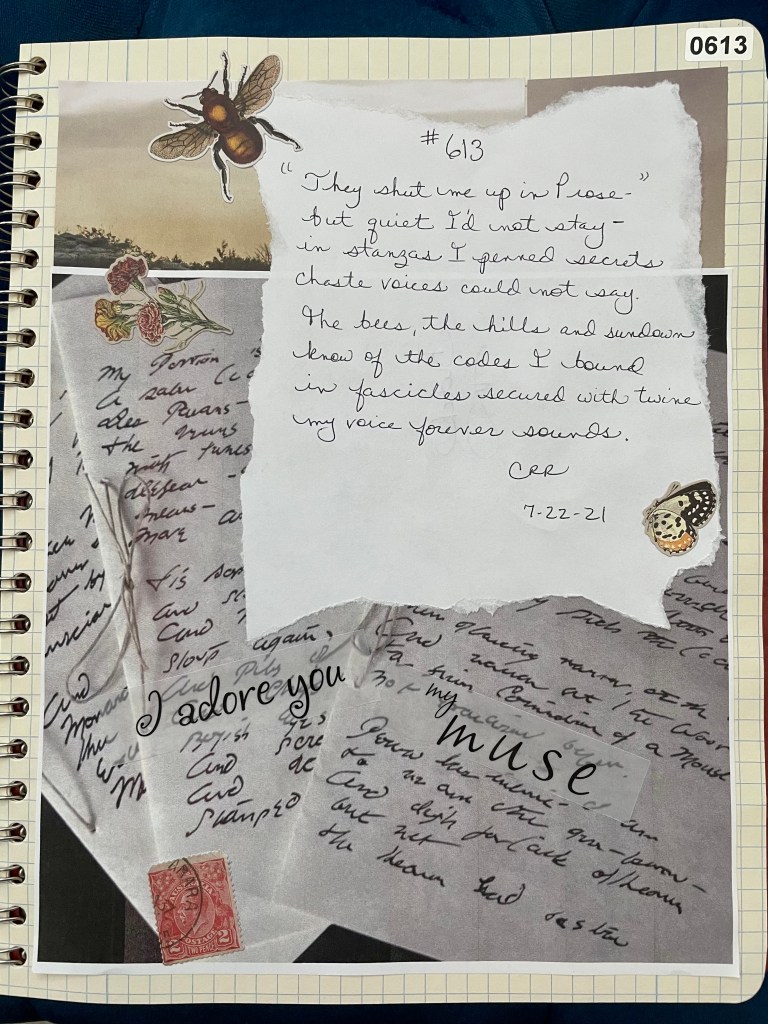
According to some scholars, Dickinson’s poem #613 is quite the exercise in feminism. In it, she masterfully uses the imagery of a captive bird and speaks in a defiant voice about the struggles of being a female, expected to be silent and kept locked up by societal expectations of the mid 1800’s.

Although she never engaged in any public romantic relationships, researchers have long questioned the many cryptic references to “loves” in her poetry and posed questions about her private life and potential relationships with several men and also with her sister-in-law, Susan Huntington Gilbert Dickinson. In my version of this poem I imagine the coded language she used to send messages that would not be deemed appropriate during her time. Over a century and a half later, fans of her work are still looking for the meanings between her lines.

Note on “fascicles:

*During Dickinson’s intense writing period (1858-1864), she copied more than 800 of her poems into small booklets, forty in all, now called “fascicles.” She made the small volumes herself from folded sheets of paper that she stacked and then bound by stabbing two holes on the left side of the paper and tying the stacked sheets with string. She shared these with no one. They were discovered by her sister Lavinia after Emily’s death.

References

They shut me up in Prose (F445A, J613) – White Heat (dartmouth.edu)

1855-1865: The Writing Years – Emily Dickinson Museum

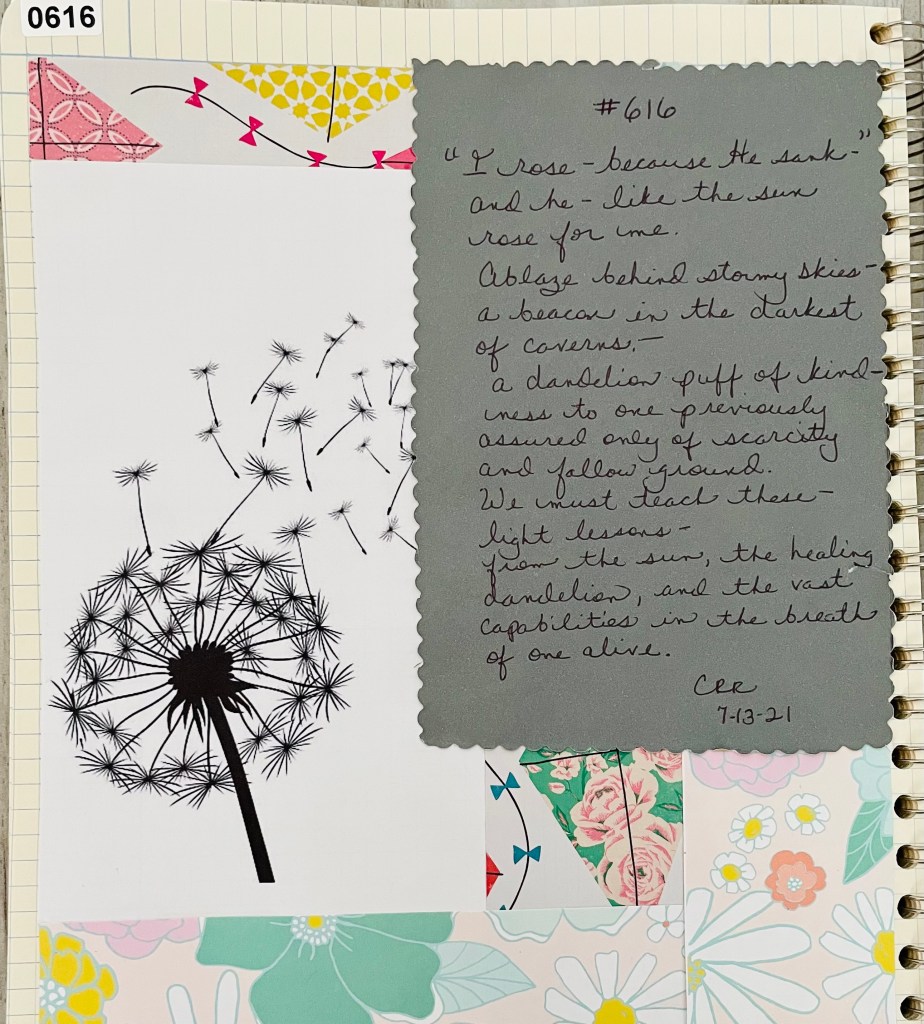
“I Rose Because He Sank”

The kindness of strangers, the devotion of one who loves or simply cares. Emily most certainly knew and exercised both herself, as have you and I. Unable to sleep any later this morning, I rose early and flipped through my catalog of first lines and chose this one. I immediately thought of all of the times others have gifted me with exactly what I was unknowingly in need of and also of those times when strangers or kind hearts have seen an obvious need and spontaneously reached out to take my hand, light my way or lighten my load. Their kindnesses served to increase the want in me to do the same.

A moment in time that would register insignificant in the chronicles of world history could be a catalyst, a lifeboat, or a key to a long locked door. We often have no idea or at least not the full extent of the impact of a small act of kindness. That’s the key to it all though, to the world being a gentler place. If we are living and breathing, if we have eyes to see or ears to detect a need, we have it in us to inspire, to educate, and to influence and affect others in a positive way. May we all rise to the occasion.

Long Time, No See

Hopefully there were a few of you wondering whether or not I completely gave up on this project. The answer is No! I was simply living the life of a writer, which sometimes boils down to write, self doubt, crumble and toss, write, self doubt, crumble and toss, pick up the pen and get distracted, pick it up again and decide to work on another project and well, you get the idea. So today I was inspired, by anger, but hey, whatever works as inspiration! Emily certainly must have had days when she experienced the same. I imagine all writers/creatives do.

So today you get not 1, but 3 poems! Hope you enjoy!

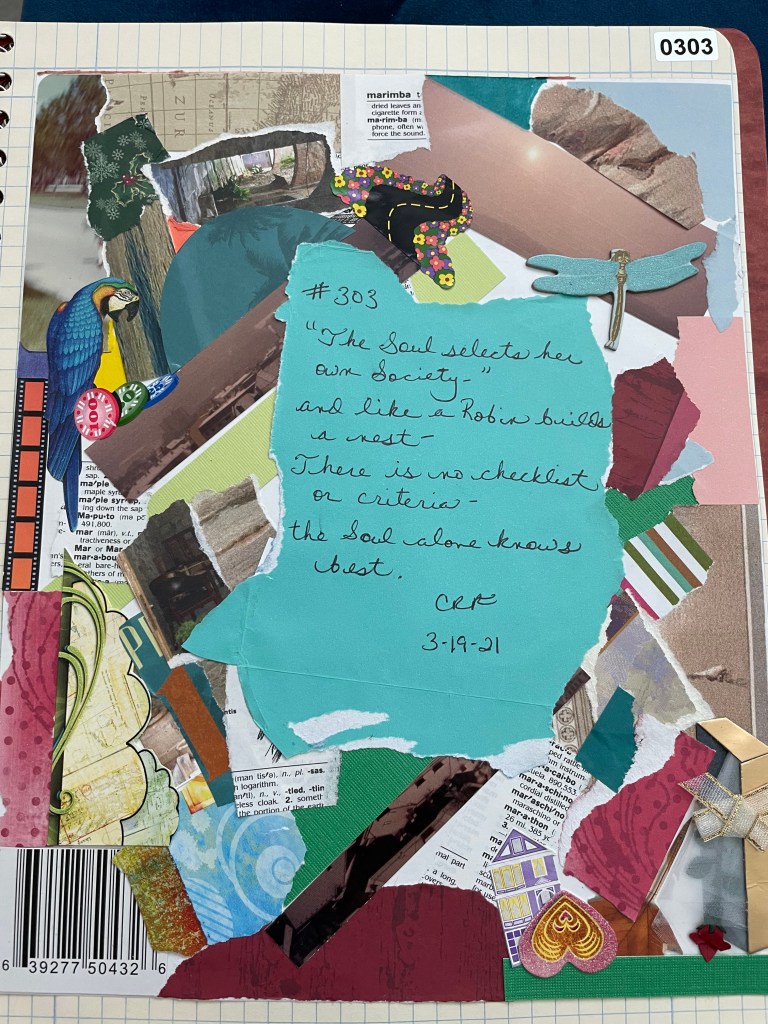
The Soul Selects Her Own Society

Emily Dickinson didn’t shy away from the big subjects in her poetry. Human nature, self identity, religion, death and the dualistic nature of our existence (body and soul) come up frequently. Spending so much time alone seems to have given her the opportunity to be very in touch with her inner self. In her poem #303, she declares that the soul chooses who it lets in that inner circle of self and that no outside entity, man or institution, should have that power. I wholeheartedly agree.

In his book titled Anam Cara : A Book of Celtic Wisdom, the late Irish poet and philosopher John O’Donohue wrote about the ancient Gaelic term “anam cara”, which means “soul friend”. When we really connect with people, somehow we just know that we were meant to cross paths. We can feel it deep inside, in our soul. We call these people our soulmates, our best friends, our forever friends. Neither time nor distance seem to weaken the bond we share with them. We can be our truest, mask-less selves with these people and they do not desert us, ever. Like a robin builds a nest for her babies, soul friends offer a soft place for the other to land.

Wishing you all an “anam cara”.

References:

Anam Cara and the Essence of True Friendship: Poet and Philosopher John O’Donohue on the Beautiful Ancient Celtic Notion of Soul-Friend – Brain Pickings

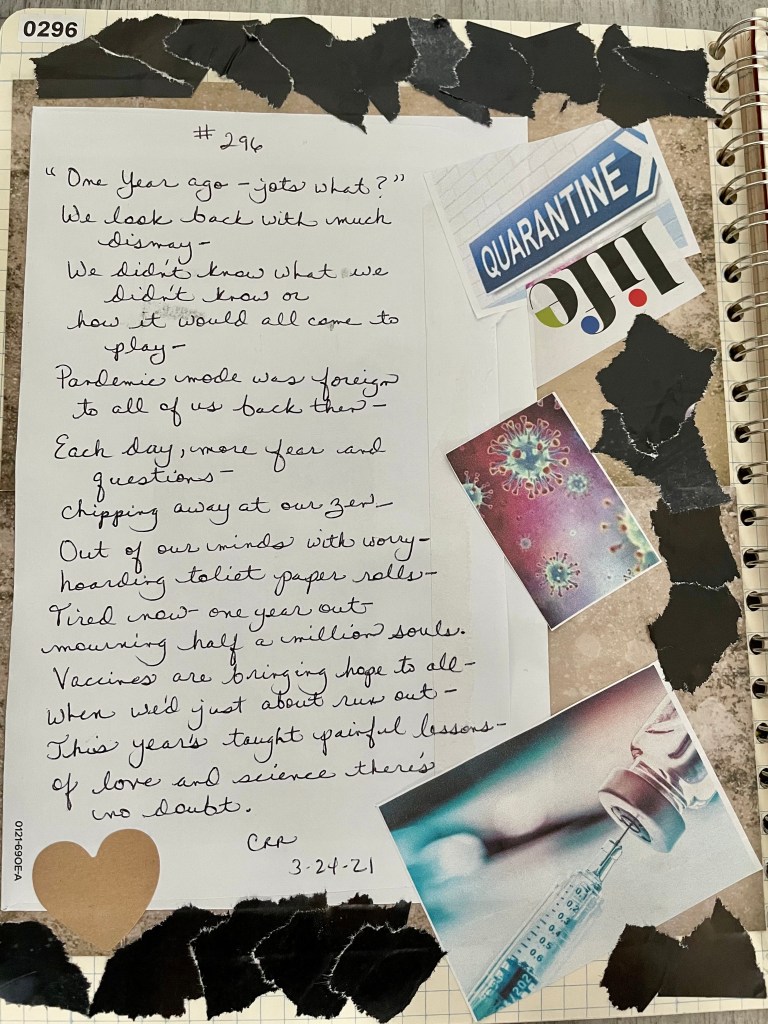
“One Year Ago- Jots What?”

In the mid 1800’s, there was a deadly civil war and multiple waves of Cholera and Scarlet Fever in the United States, but not any pandemics as great as the one we are dealing with now.

If you’ve been following me, you’ve heard me mention before that many of Emily’s poems have themes of loss and death. At the beginning of the current pandemic I couldn’t even write, couldn’t “jot” one word. I was literally frozen with fear and an overwhelming sense of loss and despair. We took the situation very seriously and really did stay home unless it was absolutely necessary to go out. For three months, my husband tried to make me laugh as he watched me sit and wallow in sadness. That’s when I picked up Emily Dickinson again. As Professor Elizabeth Sagaser of Colby College says in her essay on DIckinson: “As the coronavirus pandemic rages on, Dickinson’s poems of loss and longing can be good company.” For me, that was true and I slowly started pulling myself out of my funk.

I also had to start packing for our move, so out of necessity, was forced to get my act together.

Americans, and the world, watched the Covid-19 case numbers and deaths tick higher and higher each day. We mourned the lost lives of so many friends and loved ones and watched helplessly as the virus took its toll on everyone, young and old. We also witnessed many incredible acts of kindness and gained fresh perspectives and new appreciation for everything we’d taken for granted. Yes, we all needed toilet paper and disinfectants, but most of all, we found we needed our loved ones.

And Science. We needed Science, because you can’t just make up stuff or ignore it and end a pandemic.

And Science is coming through for us now. I just received my second and final Covid-19 Vaccine today, so I feel a renewed sense of hope. I’ve talked to others who feel the same. It’s not over yet, but we can finally see a light at the end of the long dark tunnel we’ve been hunkered down in.

Today’s Carol and Emily poem is about this past year and where we are today, thanks to Love and Science.

References:

Dickinson in Pandemic Days – Colby MagazineColby Magazine · Colby College

Little Signs Everywhere

Spring is here! Well, at least officially on the calendar and definitely here in the South. Lilies and daffodils are stretching their arms, breaking free of their cool earthy beds and peeking up at the Sun. Swollen rivers are heartily flowing as snows melt and the brown ground begins to green. Tree leaves are budding and even the oceans begin to bloom, as waters are being warmed by Spring’s sunny serving of hopeful rays. Legions of Monarch Butterflies are leaving Mexico to begin their transcontinental journey to Canada, stopping to mate and delight us all along the way. Songbirds announce their return to warmer climes as a certain fever sets in and we open our windows to the sweet smells of Spring carrying the wastes of Winter away.

Emily Dickinson was an avid gardener from a young age and according to her letters and poems, an appreciative observer of nature all of her life. Her Herbarium, a collection, of 424 plants and flowers from the Amherst region, which she catalogued, classified and pressed into a leather-bound album, is certainly evidence of that. Dickinson celebrated them in a letter to her friend Abiah Root in 1848 referring to flowers as “beautiful children of spring,” She is said to have viewed nature as her muse, and I imagine that Spring was her favorite season.

“Some keep the Sabbath going to church; I keep it staying at home, With a bobolink for a chorister, and an orchard for a dome.” — Emily Dickinson

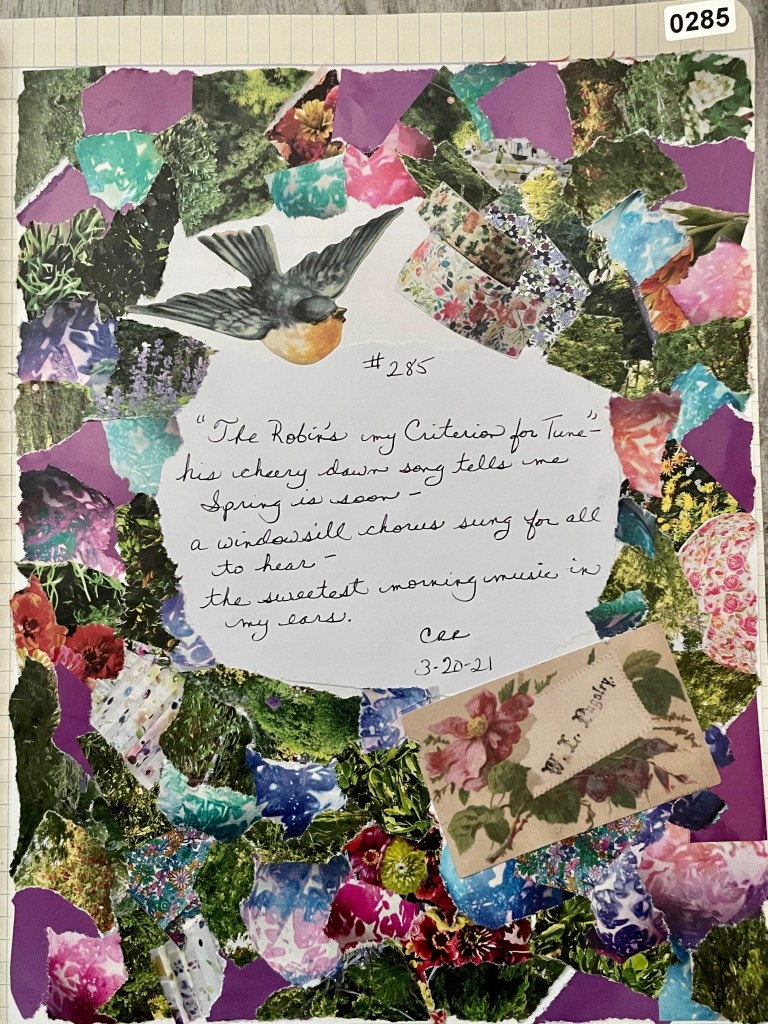
Poem #236

Like Emily, I get much of my inspiration from nature. I’m lucky to live on the coast and find much of it on the beach, which I like to say is my church, gym, and community service outlet, where I meditate, read, write, exercise and pick up litter.

Todays Carol and Emily poem celebrates one of the signs of Spring, the Robin.

References:

*View Dickinson’s Herbarium at Harvard Mirador Viewer

The Emily Dickinson Museum

One Life

I commented about self-censoring on another poet’s post today. He had admitted being hesitant to hit the publish button on a certain post of his. We writers engage in a lot of self talk, especially when the subject matter we take on is sensitive, political, controversial, etc., etc. There’s the innate need for us to create the work, to write the words, to say the things, and then there’s the need for an audience, if we actually choose to publish our work. And the audience is a huge gamble we have to be willing to take.

Dear Readers, I have to admit that I am not a Dickinson scholar, although that is now one of my goals, and something I’m working at daily. When I choose a first line of hers to use as a prompt, my process is that I write my poem and then go back and research analyses of hers, to perhaps see how my poem’s theme relates to the body of her work. The question for this poem was “Did Emily ever address current events?” The answer, like her work is elliptical and cloaked.

Emily Dickinson was most prolific during the years of the Civil War. Scholars have deemed a small group of her poems, “War Poems”. But unlike the other “Titan of American Poetry” – Walt Whitman, she told her war stories “slant”, working around the truth, and indirectly leading you to the center of it, gradually. That’s not what I did with this poem though.

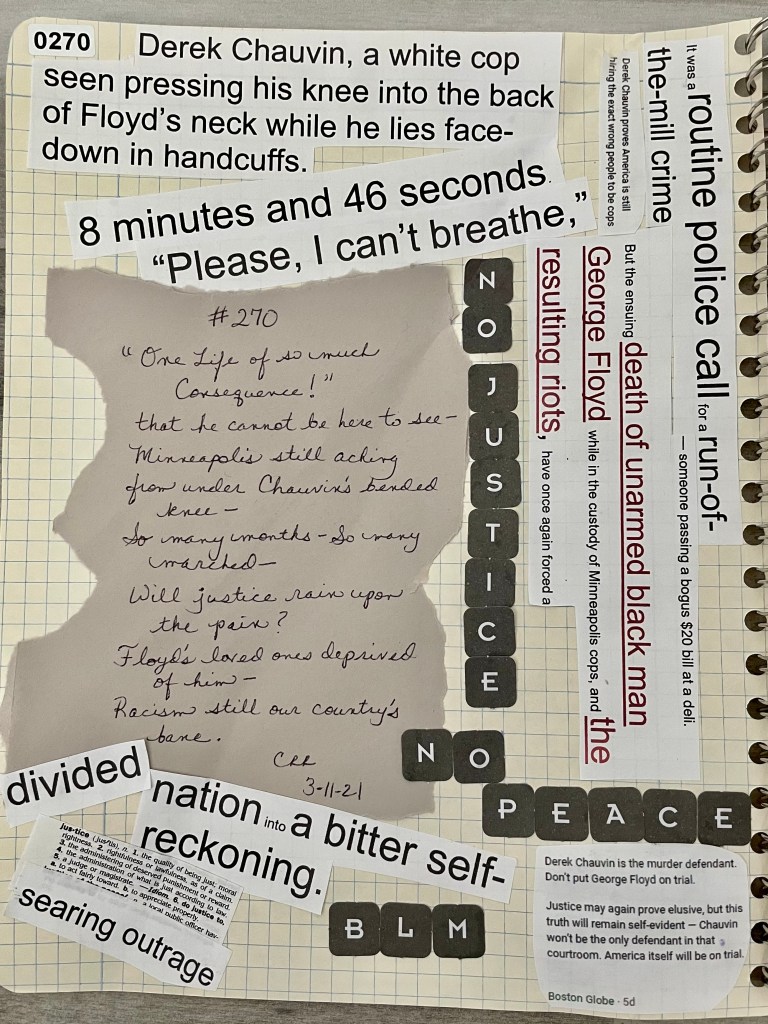
My take on #270 is very timely, as the jury selection is presently occurring in Minneapolis, Minnesota, for the Derek Chauvin trial for the murder of George Floyd. “One life of so much consequence” could absolutely have been written in another vein, about Derek Chauvin. I had a conversation with myself about posting it here. But as I wrote this poem, I was also reminded about how each one of us is a “life of so much consequence”. We touch so many others every day. The Butterfly Effects of our words and our actions are often monumental and far reaching, through generations and miles. We would do well to remember that.

References –
Walt Whitman, Emily Dickinson and the War That Changed Poetry, Forever | At the Smithsonian | Smithsonian Magazine

Boston Globe

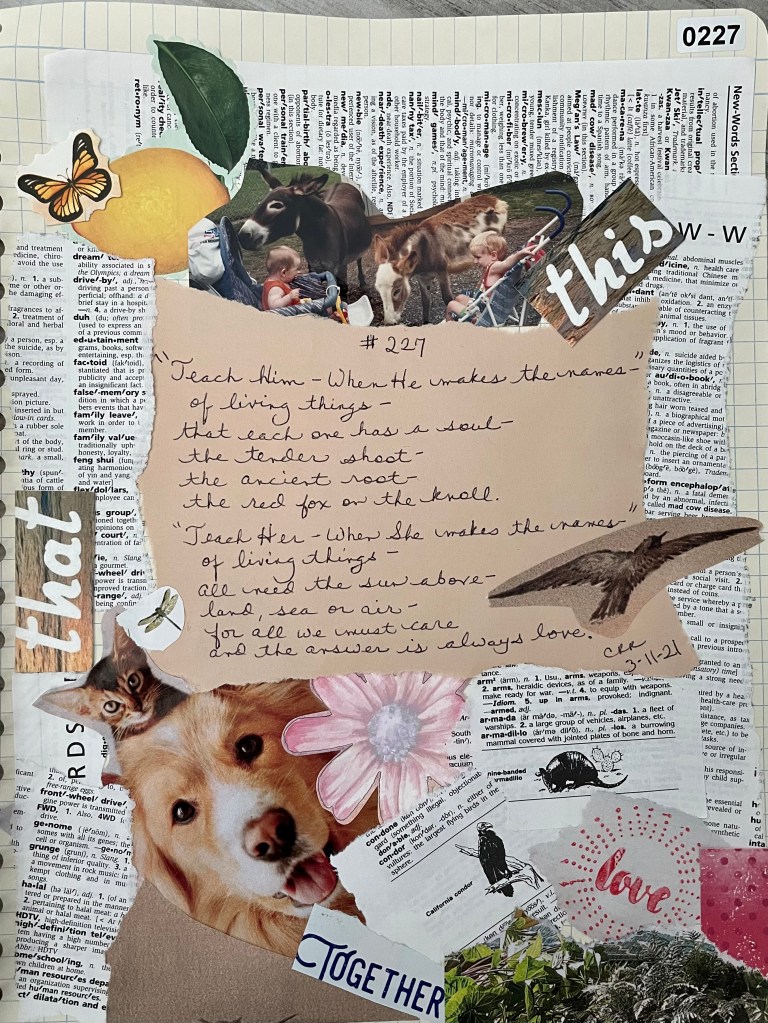
Teach Them

Today’s share is short and sweet. It’s a poem about teaching children the interdependence of all life on Earth. As we teach them the names of living things, we are hopefully teaching them about our relationship to them, theirs to each other, and the unique place each occupies in the web of life. As the renowned Italian Educator Maria Montessori taught, each living thing has a “cosmic task”, a reason for being. When we fully understand that, we can be the caretakers that we are called to be, of the environment and all of its inhabitants.

And yes, the answer is always love. ❤

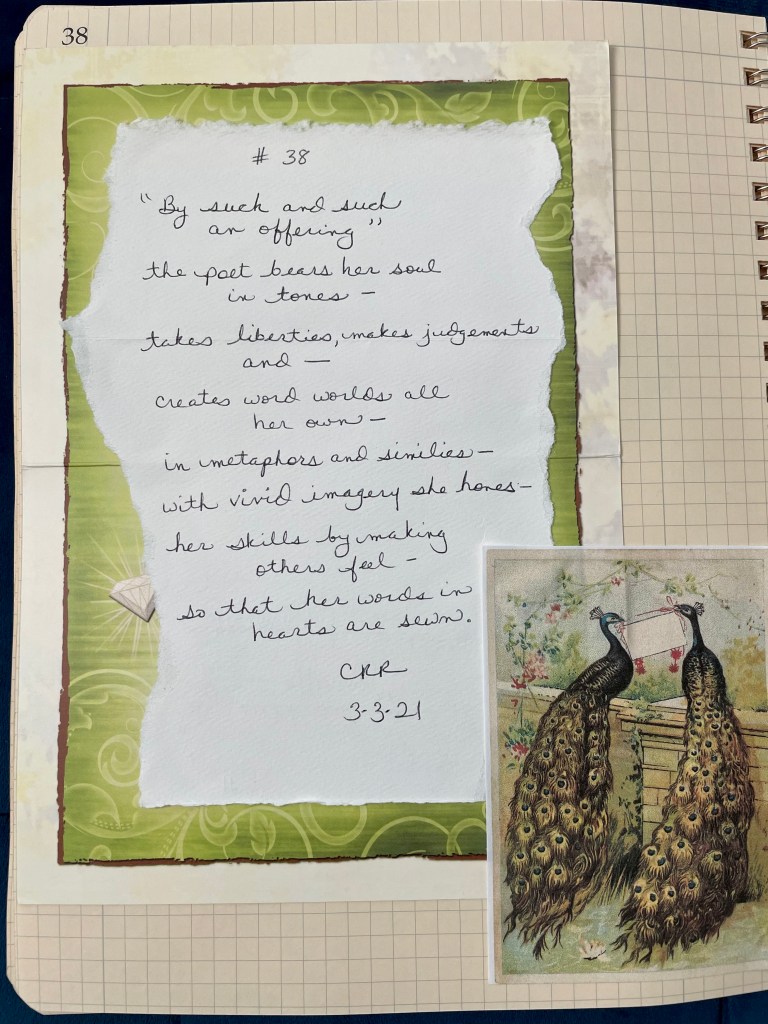
The Gift & Power of Showing & Telling

Remember that one day of the week in Kindergarten? The day you were allowed to bring that special object of yours and tell the entire class all about it and why it was special to you? That’s what writers do every day, whether they are poets or novelists, screenwriters or essayists, they tell stories and paint pictures with their words. Today happens to be International Writer’s Day, a day established to recognize and honor those who chose a lifetime of show and tell.

There’s a so called Golden Rule of Writing that says you should show instead of tell, by using sensory details that allow the reader to be immersed in the scene or emotion, as if they were there, experiencing the action or sensing a character’s personality traits. Emily was quite adept at explaining abstract concepts using imagery and concrete objects that readers could easily relate to. In other words, she was really good at show and tell. When I read her work, I get the feeling that like me, she viewed words as almost sacred conveyors of emotions, thoughts and stories. The following quote illustrates her understanding of the power they hold.

“I know nothing in the world that has as much power as a word. Sometimes I write one, and I look at it until it begins to shine.”

Emily Dickinson

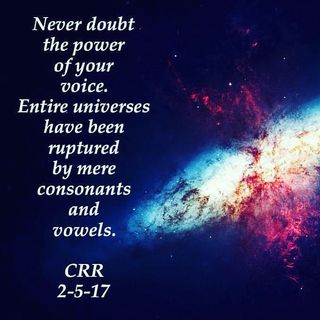
My quote about the power of words.

Today’s Carol and Emily poem is about words, writing, and the hope that in sharing our words, we writers touch hearts. And perhaps, some of our words even shine.