It’s been a moment, or 977,760. Many of them have been spent navigating an ocean of personal grief, an ocean I’ve been swimming in since the suicide of my 40 year old son, 1 year, 7 months and 4 days ago. Today, on my 66th birthday, after a long period of literally feeling like my relationship with words was also lost, I greeted this project again. Although that ocean is mine to forever swim in, I will hopefully raise my head above water and meet you and Emily regularly for word waltzes beginning with the first lines of the word gardens she planted long ago.
For those of you new to this blog, I started this project in 2021 and dreamt that I could complete it in one year. The universe is still laughing at me!
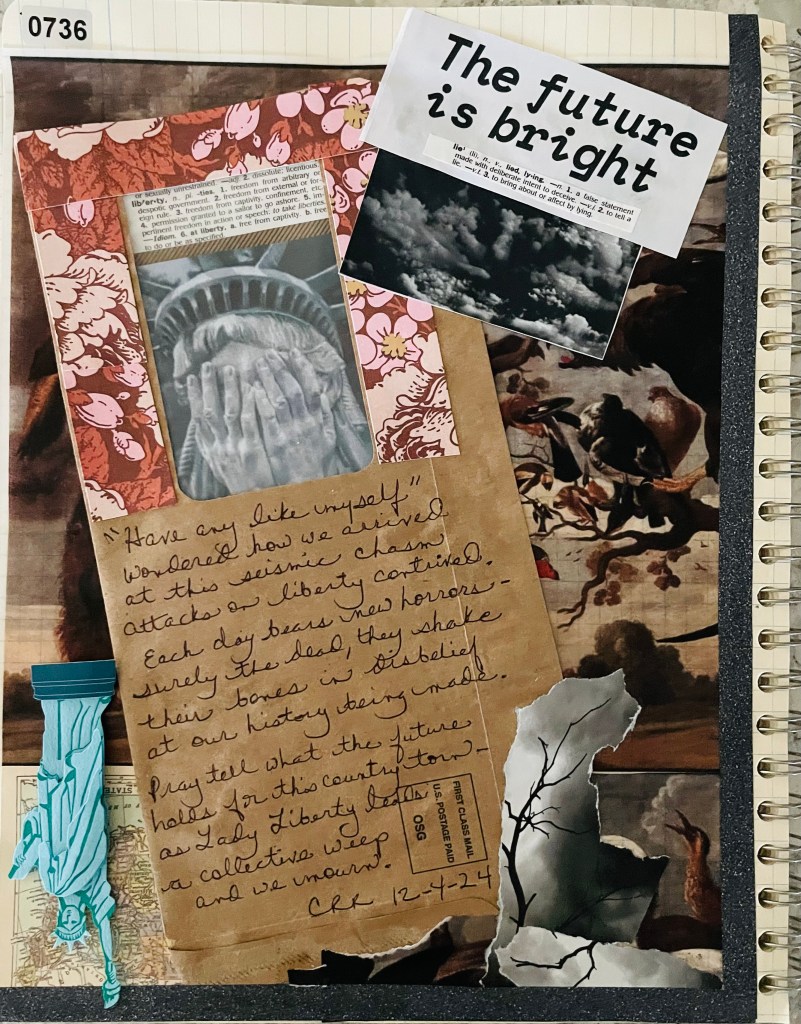
Today’s co-creation begins with the line, “Have any like myself”. In her original, Emily wonders aloud to the reader if they too have noticed what she has about the changing landscape surrounding her home in Amherst, Massachusetts and its relationship to one’s own changing inner landscapes and perceptions.
At this very moment in the disUnited States of America, our institutional and governmental landscapes are changing. The impacts of these changes are both personal and societal as our country’s future is created and reveals itself and we each deal with those changes in the ways we either choose, or are forced to.
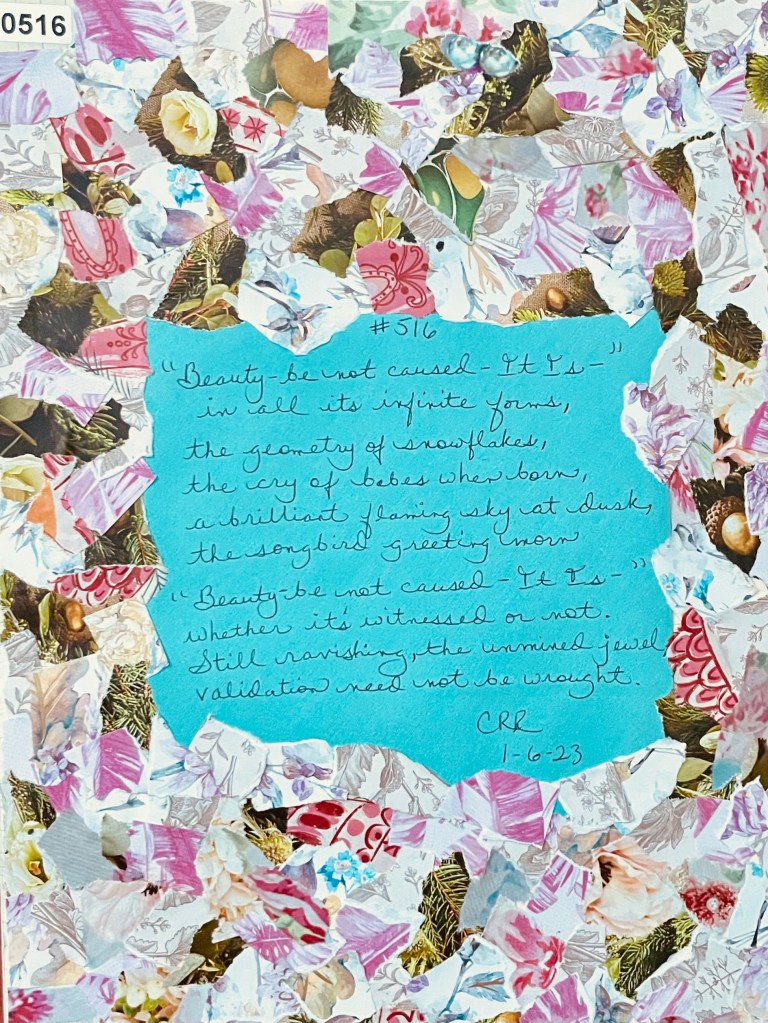
I ardently agree with Emily that beauty simply IS, its cause unidentifiable. Of course the beauty we are both referring to (and I’m assuming, since I can’t ask her) is the natural untouched beauty of the earth and all things natural in it. But it might also be the beauty we each see through our own particular lenses that could be referenced here. The judgement of beauty is said to be “in the eye of the beholder”* therefore existing in our individual minds, and I don’t disagree.
When a tree falls in the woods and no person is around to hear the noise made, the sound still occurred and existed. Similarly, I have proposed that an unviewed object’s beauty is not lessened by the fact that it goes unviewed. Unappreciated, yes, but still, its “beauty IS”.
There are so many types of natural beauty in the world that we could begin an adventure to seek them all out, and never complete the journey, for it abounds everywhere. In my humble opinion, that’s exactly how we should live our lives though, hunting for the beauty in everything, everywhere, consciously, all the time. In some ways, and sadly increasingly, it’s actually a basic and necessary survival skill, given the fact that all kinds of ugliness coexists in our world as well.
Emily never ventured far from her home to seek beauty, but she sought it out all around her and appreciated its myriad of expressions in nature and in the written and spoken word. I think I’ll follow her example.
*Most sources attribute the first use of the modern-day expression to Margaret Wolfe Hungerford (née Hamilton) who wrote a number of books under the pseudonym of “The Duchess,” and, in her 1878 work Molly Bawn, wrote “beauty is in the eye of the beholder.”
Today’s first line comes from one of the earliest collections of Emily’s poetry published in 1896, 10 years after Emily’s death, by Mabel Loomis Todd, a family friend and also the mistress of Emily’s brother, Austin. Thomas H. Johnson published the entirety of Dickinson’s poems in 1955 and numbered them according to his judgment of chronology.
The original poem is just four lines and is said to be about her bedroom, where she spent most of her life and where the shadows certainly would have increased as she faced ill health in her last days.
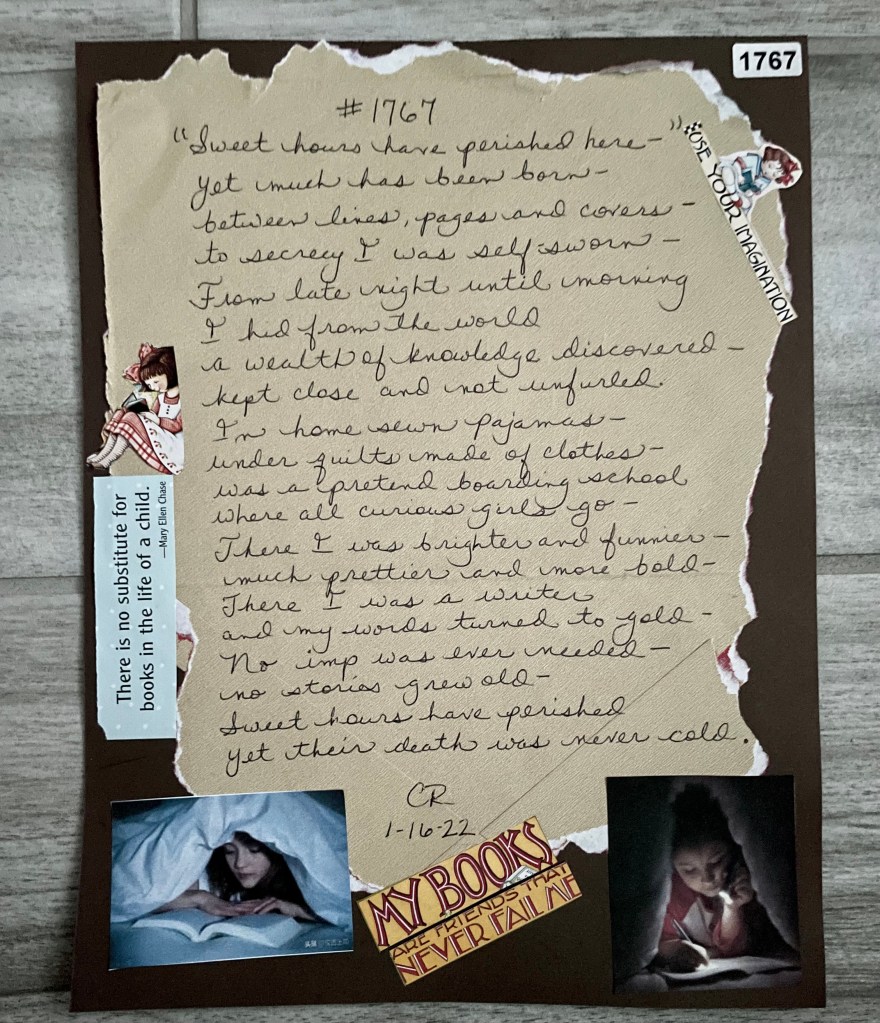
Sweet hours have perished here;
This is a mighty room;
Within its precincts hopes have played,-
Now shadows in the tomb.
Emily Dickinson
J1767
I took the first line and reflected on my childhood, when books and writing were personal havens for me. Long after I should have been, I could almost always be found under the covers writing or between the covers of a book, being whisked off to an imaginary place I was reading about, or coveting some snippet of knowledge I had to sneak to learn. Indeed, it was my happy place and the hours that passed on there were never mourned.
From March- August you can even spend an hour or two in Emily’s own “mighty room”, which has been preserved in the Dickinson family home in Amherst, Massachusetts. Click this link for details. (It’s definitely on my Post-Covid Bucket List!)
Hope is the thing with feathers That perches in the soul, And sings the tune without the words, And never stops at all,
And sweetest in the gale is heard; And sore must be the storm That could abash the little bird That kept so many warm.
I’ve heard it in the chillest land, And on the strangest sea; Yet, never, in extremity, It asked a crumb of me.
– Emily Dickinson
The first stanza of this poem is one that is well known. What I get from this collection of Emily’s words is that Hope doesn’t cost a thing. Granted, the cost of fulfilling those hopes might take more than wishful thinking, but no matter our station in life, we can all afford the miniscule cost of giving another soul hope.
Because it’s New Year’s Eve, and I’ve got other projects calling my name, I’m not going to write my version of Emily’s poem #254 today. I’m going to cross over to my other blog and share my wish for all of you, that as you leave 2021 behind and enter into 2022, you take these words to heart, knowing that you were made for joy.
191 years ago today, Emily Dickinson was born. How amazed would she be to know that her words would survive and become such a legacy to the world? As a little girl, she was the first of many poets I would come to admire and treasure, poets that would inspire me and make me marvel at the mystery of it all, as well as the magic created by mere consonants and vowels put together in just the right way to reveal entire astonishing worlds.
As we celebrate her life today, I imagine that being the introvert that she was, like me, she would at times find a celebrated public life tedious.
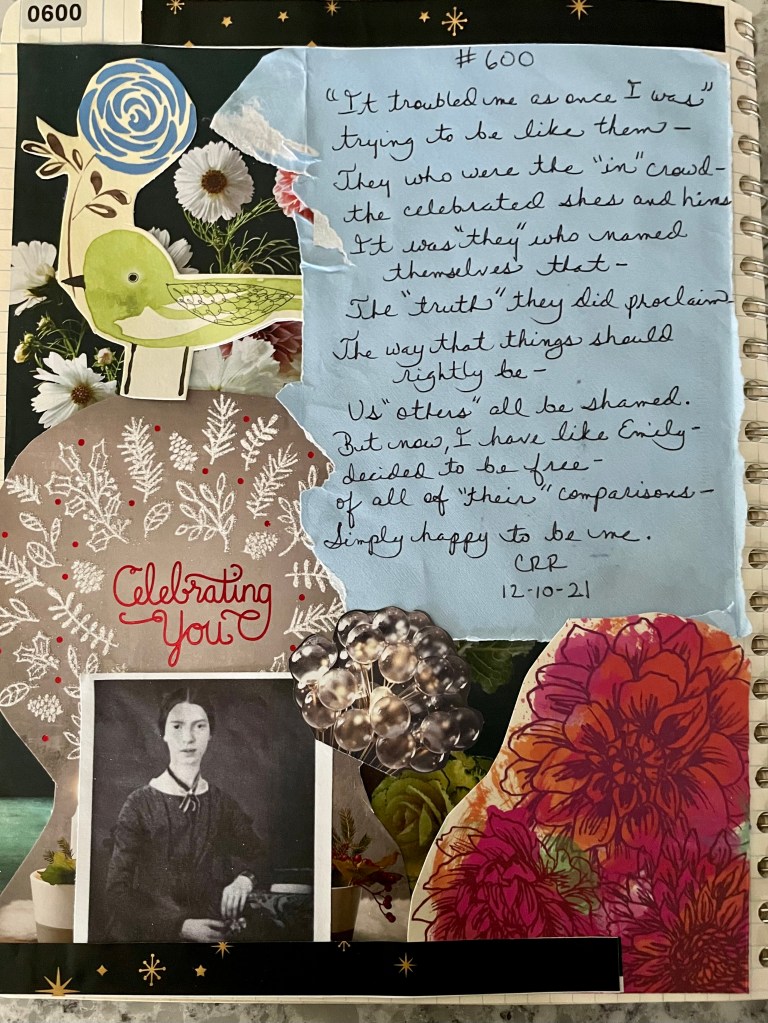
The first poem I ever memorized was her #600:
I’m Nobody! Who are you? Are you – Nobody – too? Then there’s a pair of us! Don’t tell! they’d advertise – you know!
How dreary – to be – Somebody! How public – like a Frog – To tell one’s name – the livelong June – To an admiring Bog!
Emily Dickinson
One of the many ways I relate to Emily is in the comfort found in nature, wherein lies a soothing solace, a buzzing energy, and an all-encompassing mystery that one desires fervently to live in and write about. Emily had her gardens. I have the oceans and the multitudes of life they hold. We have both found inspiration and understanding through the act of writing.
From Mount Holyoke Female Seminary, which Emily attended at 16, she wrote to a friend at home,
“There is a great deal of religious interest here and many are flocking to the ark of safety.”
Emily refused to be part of the flock. For her failure to accept the veneer of things, she was dubbed by the principal of the school to be one of the “No hopers”, the group of girls who were labeled as having no hope of salvation. I would venture to guess that quite a few of my own teachers had me on a similar list.
Maria Popova in The Marginalian writes of Emily Dickinson:
“She was far more interested in the arc of knowledge as science was just beginning to bend its gaze past the horizon of old certitudes. What lay there would come to animate a great many of her spare, stunning poems — poems that illuminate the eternal, the elemental, the inevitable through the pinhole of the surprising. “
Peering through “the pinhole of surprising” or “telling it slant” is something Emily was quite adept at, as in poem #1263 she writes;
Tell all the truth but tell it slant —
Success in Circuit lies
Too bright for our infirm Delight
The Truth’s superb surprise
As Lightning to the Children eased
With explanation kind
The Truth must dazzle gradually
Or every man be blind —
Being the skilled poet that she was, she didn’t seek “define” the truth, which opened the window of understanding and connection to readers who each approach it via different circuits and on their own terms. As an adult, I’ve come to understand that we do not all share the same truths, nor should we be expected to and as writer I hope to accomplish the same thing Emily did in her poems.
From an early age Emily broke with convention, not accepting the traditional role and conventions that women of her time were expected to adhere too. Veering off road like that can sometimes be a painful and solitary trek, something I can personally attest to. But doing so also allows for individuality and maximum growth, which I explore in my alteration of poem #600.
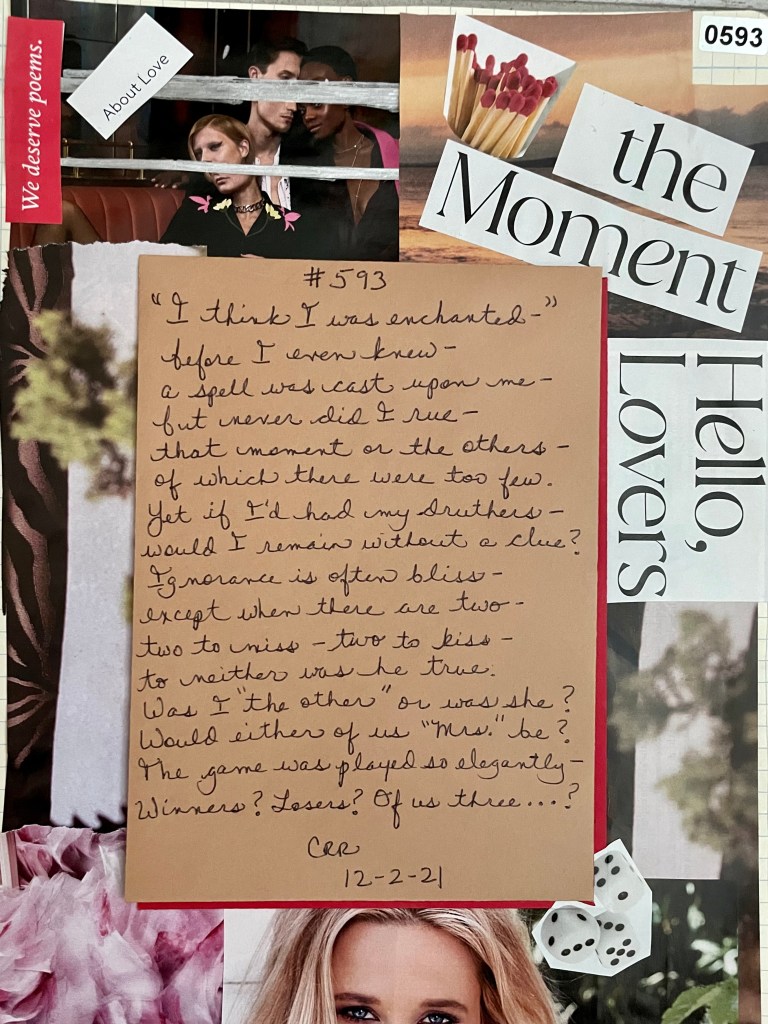
Emily Dickinson’s poem #593 is a complex and deep ode to poetry and all that it encompasses. It’s one of those that you have to read numerous times before you even begin to understand all of the mystical references, imagery, and connotations. There are references to nature, witchcraft, another female writer and many metaphors about the light that rises from the darkness. Each time I reread it I get something deeper from it.
My alteration of #593 is much simpler. It’s one of those tales as old as time that I’d guess the majority of us humans have either experienced or can relate to. You know the story, girl meets boy or vice-versa, but one is hiding something. One kind of senses, but doesn’t want to. The whole play eventually comes to an end, and one could regret it or be mad, but it was still such a really good thing, just at the wrong time. I’m sure there’s a country song (or two or twenty), that describe that kind of situation perfectly…
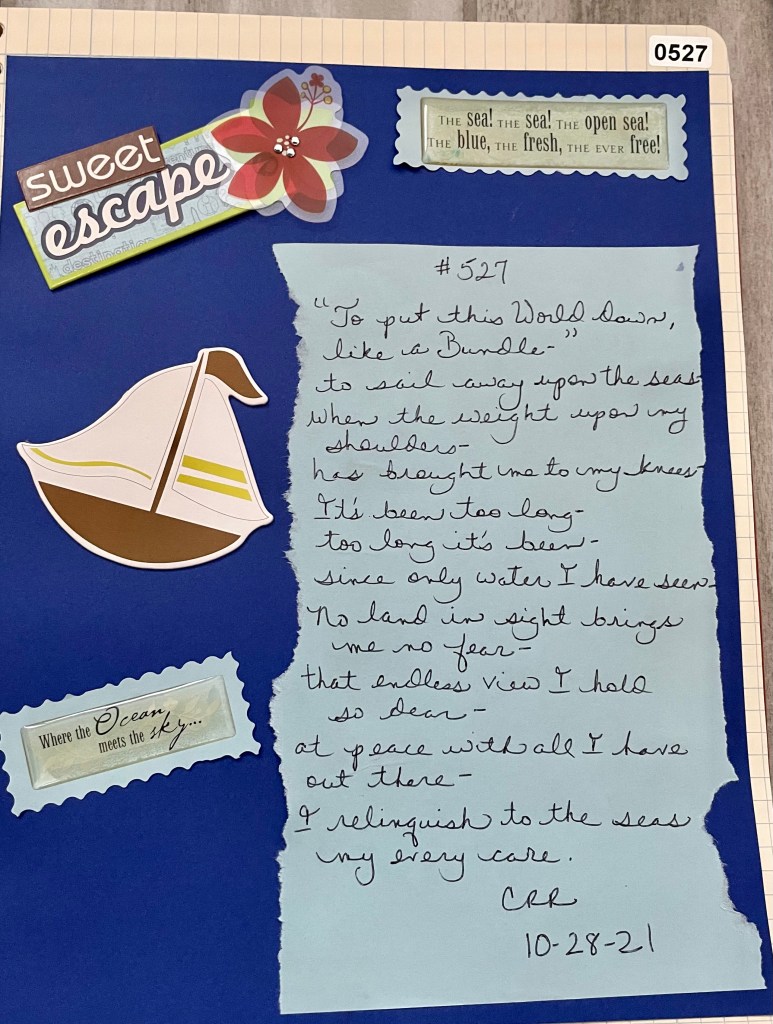
Emily Dickinson wrote quite a lot about religion, death, grief and existing outside of the commonly accepted lines of her time. In poem #527 all four of these topics appear as she talks of renouncing the world and references Jesus’ renunciation and consequent agony and crucifixion.
Then, as now, life can be overwhelming and hard and we just need to put the burden bundle down for a bit, close the door on it (or open another). Being on the ocean and especially far from land has always been the salve I need. It’s there that I go off the grid, leave technology behind and imagine myself as one with the sea, powerful, full of wonders, and with endless horizons. I long to be there now, landlocked as I have been by the pandemic woes of this past almost 2 years.
This too shall pass, this I know. And when it does, I will “put this world down like a bundle” for a time and cruise away.
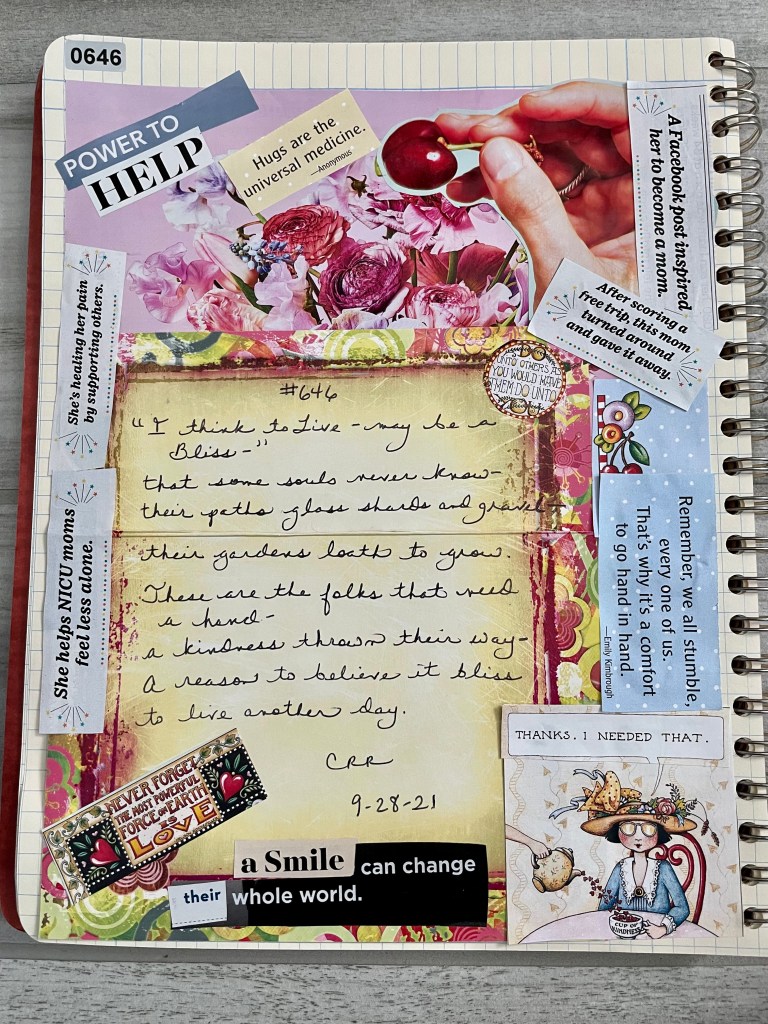
By all accounts Emily was not born an “unhappy child”, but she did go on to experience significant losses that affected her deeply and contributed to the abundant theme of death in her work. In her poem #646 Emily seems to say that there is a lot more joy out there to be had than she has experienced in her self-chosen cloistered life. She hints in the last stanza that a certain unnamed someone may hold the key to making it all Bliss:
How bountiful the Dream— What Plenty—it would be— Had all my Life but been Mistake Just rectified—in Thee
Emily Dickinson
I have known people who never seem to get a break, never find that golden ticket, and spend their whole lives trying to keep their heads above water, choking and almost drowning again and again along the way. They may experience slivers of happiness here and there, but Bliss is a foreign word to them because they just haven’t had the chance to experience it.
I also know that you can seemingly have it all, or what looks like it all, wrapped up beautifully in gold and still not have a life filled with Bliss. (defined as extreme happiness, utter joy). Life is just not like that, as tragedy and loss strike us all.
As our individual paths converge with others, we’d do well to remember that we have no idea what stories, burdens and losses others carry under the skin of their public self. What we do know is that a kindness, a hand or a smile reaching out to them, without a request or expectation back, is a universally appreciated gift.
This morning I went to have blood drawn for my upcoming physical and witnessed a perfect example of someone trying their best to make everyone smile, to bring a little Bliss to each person’s day. The lab tech’s name was Sandra and she had a kind word and or compliment for every person she dealt with. It took little effort, but you could tell that people appreciated her. They thanked her, laughed with her, or like me, wished her a wonderful day before they left. Then they took that little bit of happiness she shared with them and went their own ways, surely smiling under their masks and hopefully inspired to fulfill the butterfly effect and share it with someone else.
We’ve all experienced how one word, one interaction, can ruin a good day. We can’t individually solve everyone’s problems, but we each have the power to help bring a little bit of joy, bliss, or happiness to other’s days. And sometimes that goes a long way towards helping someone believe that life is truly good, prompting them to share that goodness with someone else, and making our world a kinder, gentler place for us all.
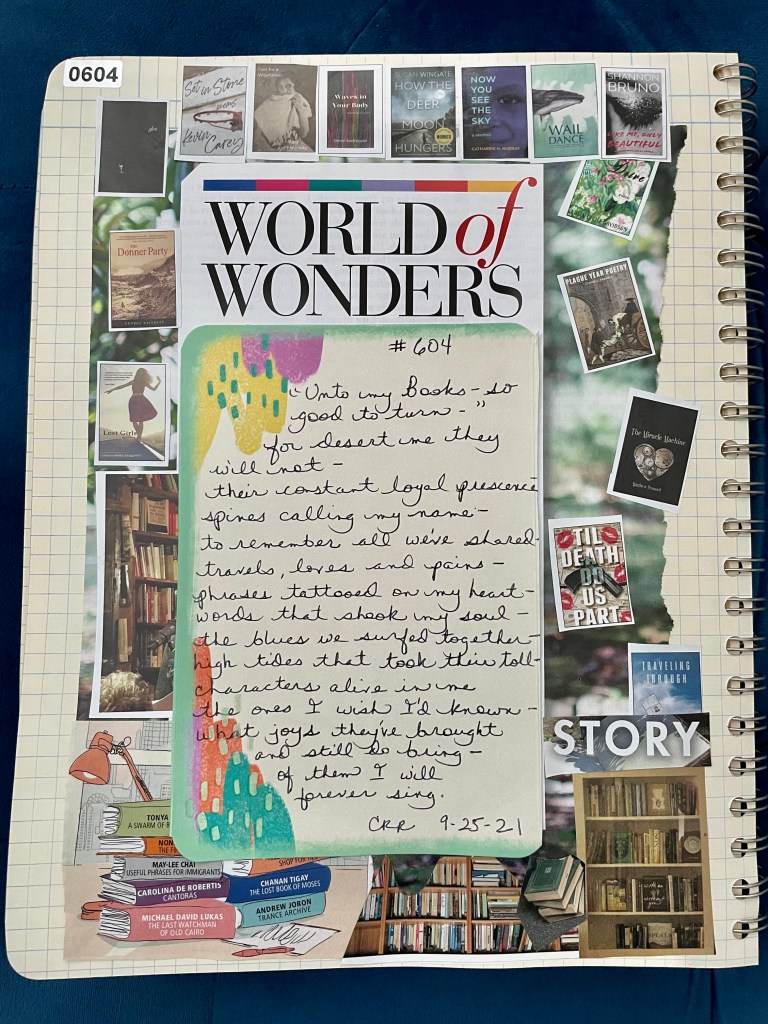
In her poem #604, Emily expressed her never waning passion for books. Known for being a homebody and preferring her book shelf and garden to engaging with others, she was a well read woman and like all writers, delighted in reading when she wasn’t writing.
“She was born into a book-loving household and became a voracious reader who read widely.”
Emily Dickinson Museum
“I am glad there are Books. They are better than Heaven, for that is unavoidable, while one may miss these.”
– Emily Dickinson to F. B. Sanborn, about 1873 (L402)
Books have saved my life a thousand times. They’ve inspired me, challenged me, terrified me, delighted me, comforted me, enlightened me and expanded my understanding of humanity. I’m the girl that will walk straight to your bookshelf and peruse it for clues to who you are. Take me to a bookstore or library and you’ve opened the door to my heart. Don’t expect me to leave very soon though, for like Emily, I think books are better than Heaven.
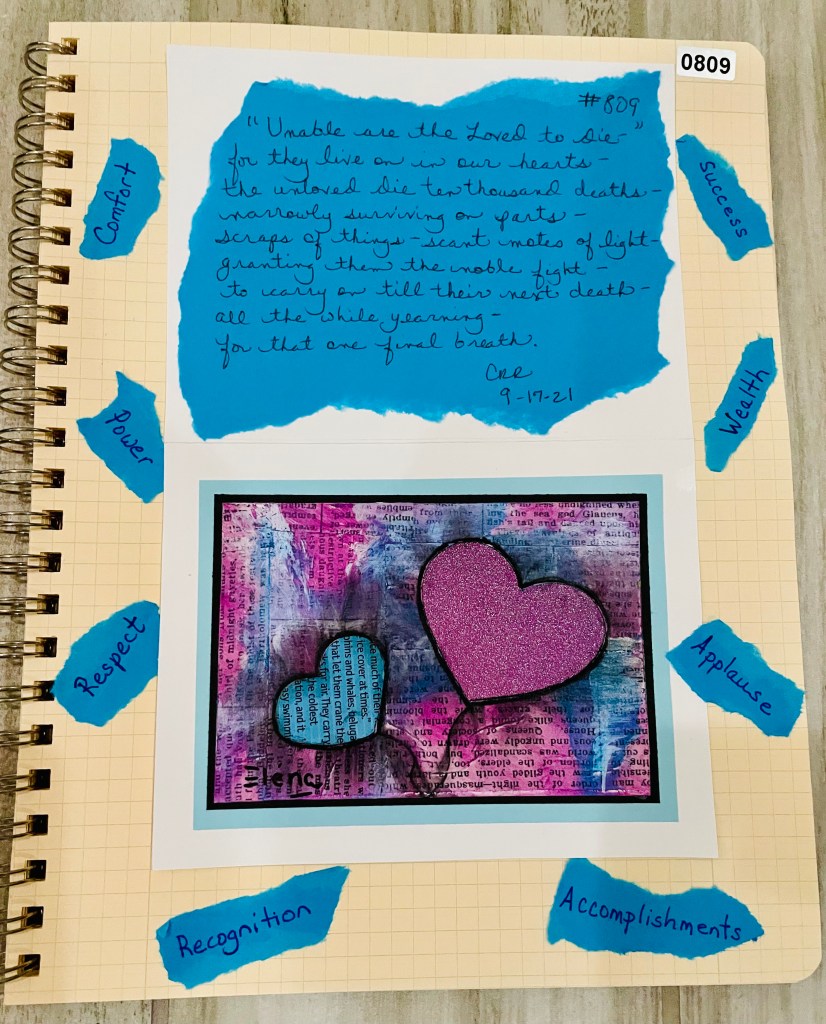
If we have ever loved a pet or human, we know this to be true. That even after they are gone from this physical realm, they live on in our hearts. If you were to Google quotes about love and life you should be prepared to go down a chasmic rabbit hole, only to emerge weeks later with one great truth- stated a thousand different ways in a myriad of languages, cultures and religions…
“To love and to be loved is the greatest happiness of existence.”
Sydney Smith, in Lady Holland’s Memoir (1855), “Of Friendship”
And if ever there was a poignant pregnant line spoken by a character and lived for too short a time by the actor who played him, it is this one.
“Poetry, beauty, romance, love, these are what we stay alive for.”
Robin Williams as John Keating in Dead Poets Society
In the first line of her poem, Dickinson likened love to immortality and I have done the same with my poem, while exploring the quality of a life without love, or as in Robin Williams’s case, a life so clouded by depression that one is rendered unable to sustain him/herself. We can survive for a time on all the other things, the scraps, like wealth, recognition, applause, etc., but on the table of life the main dish is love and if we don’t get to partake in and share that, no amount of those other things will ever satiate our souls.


 The Carol and Emily Project