“Just So-Jesus Raps”

I for one was extremely curious that Jesus actually was rapping back in the day. Could he have been the Original L L Cool J? Cool J’s real name is James and the LL stands for Ladies Love (Cool James). You know how everyone finds religion in prison? Jesus might have been LL Cool Jesus ( Lawbreakers Love Cool Jesus)!

Come to find out, Emily was writing about the other kind of rapping, Jesus rapping or knocking on a door. She goes on to write about how she begins rapping on the door of her beloved’s heart. In this instance, as in many in which Emily writes of an unnamed love, we can assume that the heart she was referring to was that of her beloved best friend and eventual sister-in-law, Susan Dickinson, to whom she is said to have written and hand delivered this poem.

For my version of #317, I decided to visit current events here in the USA and speak to those who probably don’t want to hear what I have to say, but I’ve never been one to shy away from “Good Trouble”. You’ll have to imagine it spoken by a competent rapper, because that I am not.

In the words of the late great human rights activist Representative John Lewis:

“When you see something that is not right, not fair, not just, you have to speak up. You have to say something; you have to do something.”

Across That Bridge: A Vision for Change and the Future of America

#317

“Just so- Jesus raps-“

Just so – so you know

I didn’t look like those pics they show.

But oh hell yeah- I did throw

the temple tables of all of those

making money as religion’s hoes.

Religion should help, religion should support.

Keep your right-wing asses out of court.

Get your feet

out on the street

and minister to people who need to eat.

Take your pro-life banner and tear it up.

Put your money where your mouth is and show my love.

For all the foster kids with no homes-

The vets who on your streets do roam-

The women and men working night and day

who still don’t get enough in pay

to have a decent place to live-

You say you love me, so what gives?

Fix these problems before you stick

your pompous nose in the thick-

of a woman’s inalienable right to pick-

what her own body does and doesn’t do.

Really? Who the hell are you?

It’s not your choice.  I’m not your guy.

And if you can’t see the reasons why

I’ve rapped these words,

then your heart is blind.

Love is love. A woman’s body is her own.

Now do my REAL WORK

or shut up and stay home.

(mic drop)

CRR 9-16-21
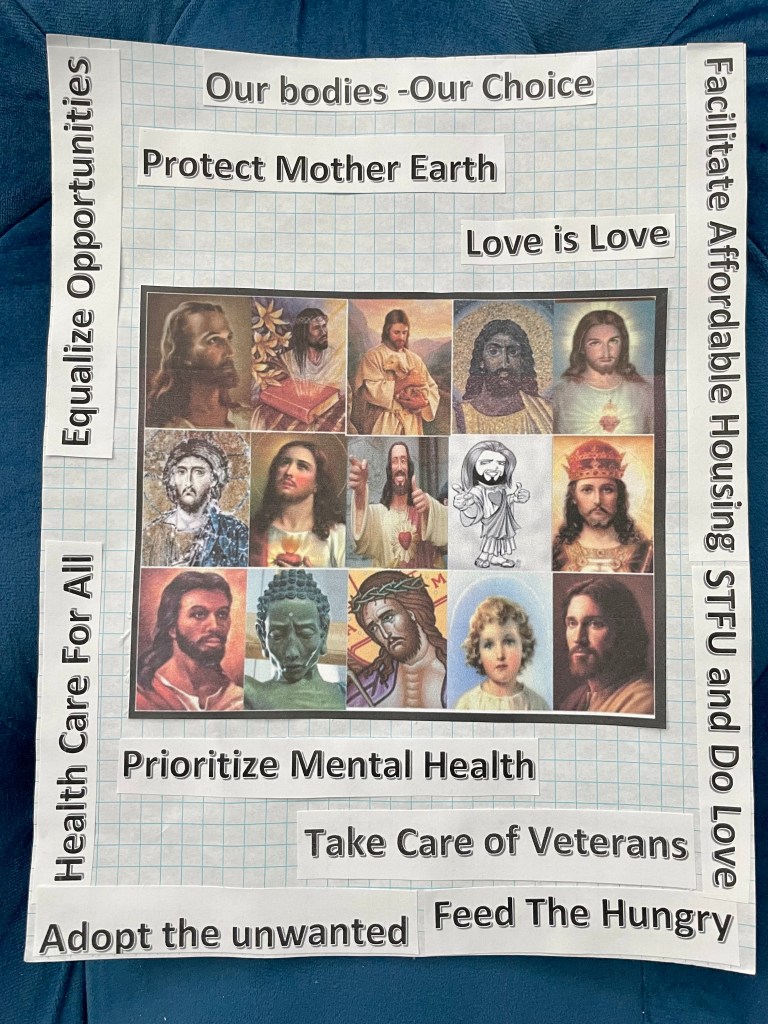
Picture credit https://www.orthodoxroad.com/the-many-faces-of-jesus/

“A Thought Went Up My Mind Today”

It seems much of what I’ve written lately follows the theme of both random and not so random worrisome thoughts swirling through my mind at inopportune times. Times when I need to clear my head, relax, or sleep peacefully. I could try to assign it to Pandemic Brain, but this phenomenon is not at all unusual for me. I tend to plan in my mind for the worst case scenarios so I will be relieved when anything less than that happens. As a mother, I still irrationally question what part I have in any unfortunate situations my adult child gets into. That mother guilt. Those what ifs. Those if onlys. Those would have, should have, could haves.

In her poem #701, Emily wrote of having a thought reoccur Deja vu-like (my interpretation), but being unable to determine from where it came. I’m sure many of us can relate to both of these instances.

“I Meant To Have But Modest Needs”

The themes of death and prayer come up often in Emily Dickinson’s work. Her #476 recounts praying to God only that she might be content and also go to Heaven. She then experiences a feeling of doubt about the Bible verse ,”Whatsoever you asketh, that shall be given you,” renders herself fooled like a child and moves on. Many of her poems reflect the conflicts and doubts she experienced when it came to committing herself to the organized Christian church. Unlike the rest of her devout family who went to church each Sunday, Emily preferred to keep the Sabbath at home.

According to The Emily Dickinson Museum, “Emily Dickinson lived in an age defined by the struggle to reconcile traditional Christian beliefs with newly emerging scientific concepts, the most influential being Darwinism. Dickinson’s struggles with faith and doubt reflect her society’s diverse perceptions of God, nature, and humankind.”

https://www.emilydickinsonmuseum.org/emily-dickinson/biography/special-topics/emily-dickinson-and-the-church/

My poem #476 is quite different from Emily’s. It deals with a “first world problem”, the issue of having experienced a higher standard of living and later not feeling inclined to settle for anything less!

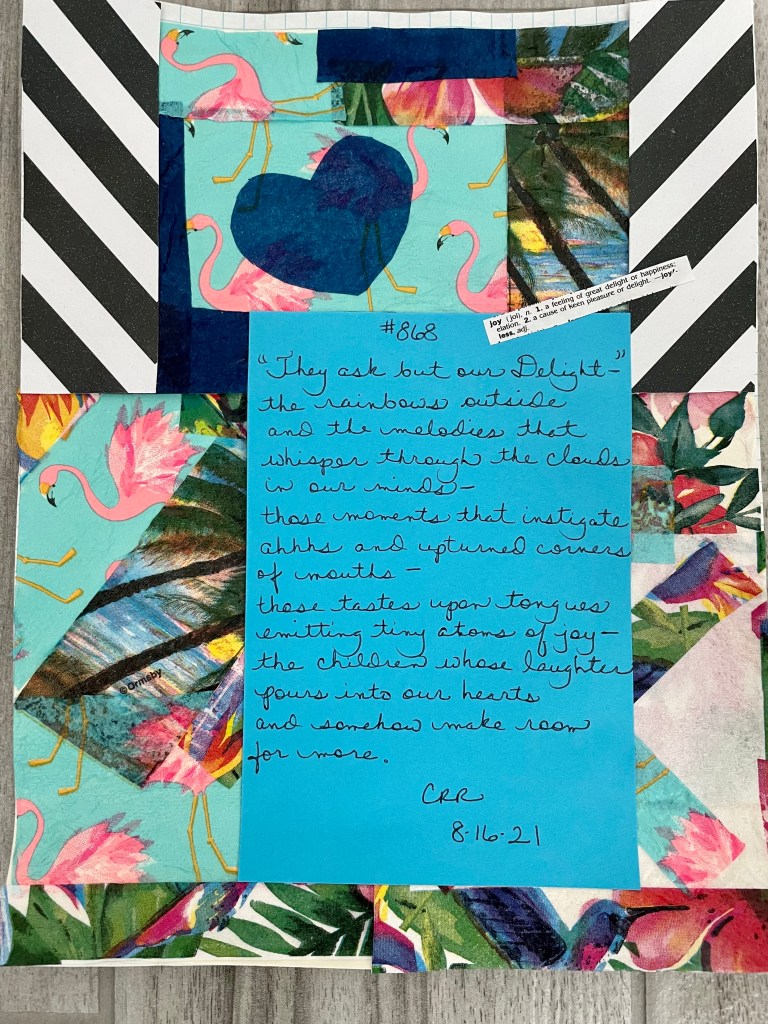
“They Ask But Our Delight-“

The collage background I chose for this poem is just a fun little thing I did with leftover scraps from another decoupage project. I delighted in making it, so I guess that’s its connection to today’s poem #868. Emily’s poem was about flowers and all the other “darlings of the soil”. Mine recounts the first 5 things that came to mind as I pondered delight. Perhaps I’ve prompted you to do the same.

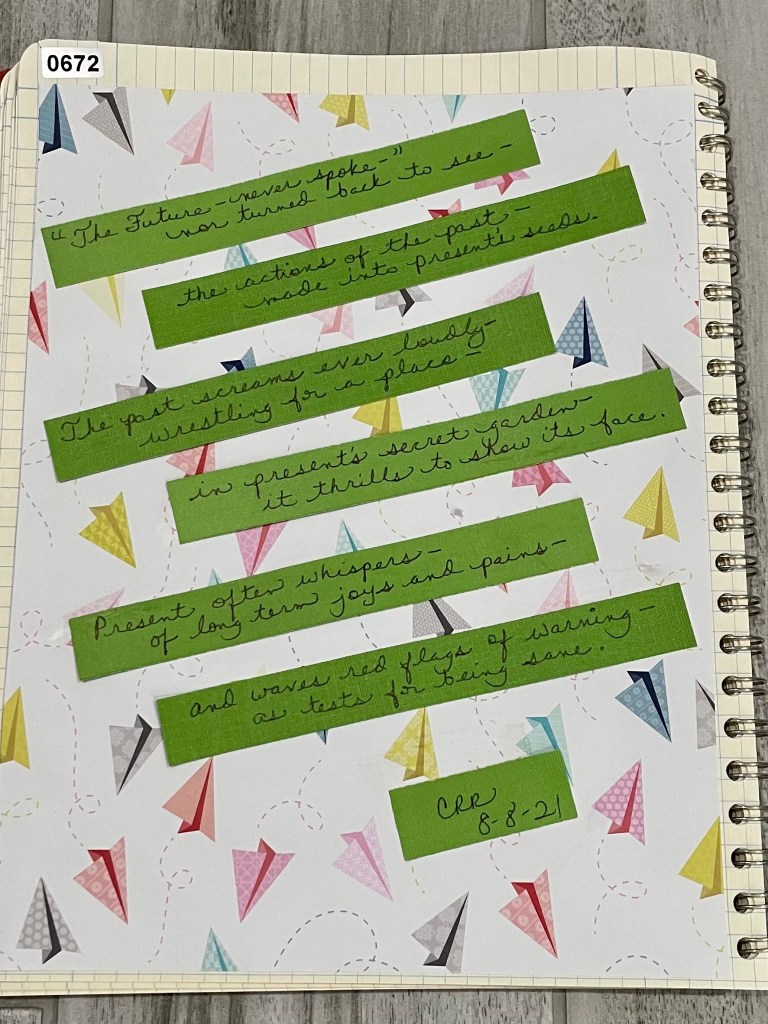
“The Future Never Spoke”

My process for writing these Carol and Emily poems is to try NOT to read Emily’s before I write mine. Although I’ve read much of her work at one time or another in the past, for the purposes of this project, I tried to only read the first lines and wrote each one of those on the top of a page in a huge stack of journals. During each writing session, I randomly choose one and flip through it, until I come upon a first line that strikes me, and I go to work on that. After I’ve written my poem, I go back and read Emily’s as well as any analysis of it.

Her work is more often than not, generally associated with the words cryptic, enigmatic and mysterious. Poem #672 is unlike the larger body of Emily Dickinson’s poems, in that it’s more straightforward than most. She rather simply personifies “Future” and explains how it never lets on what is going to happen. I personified Past, Present, and Future in mine, as I waxed poetic about the evolution of time as it affects humankind in a myriad of ways. Hope you can relate and enjoy!

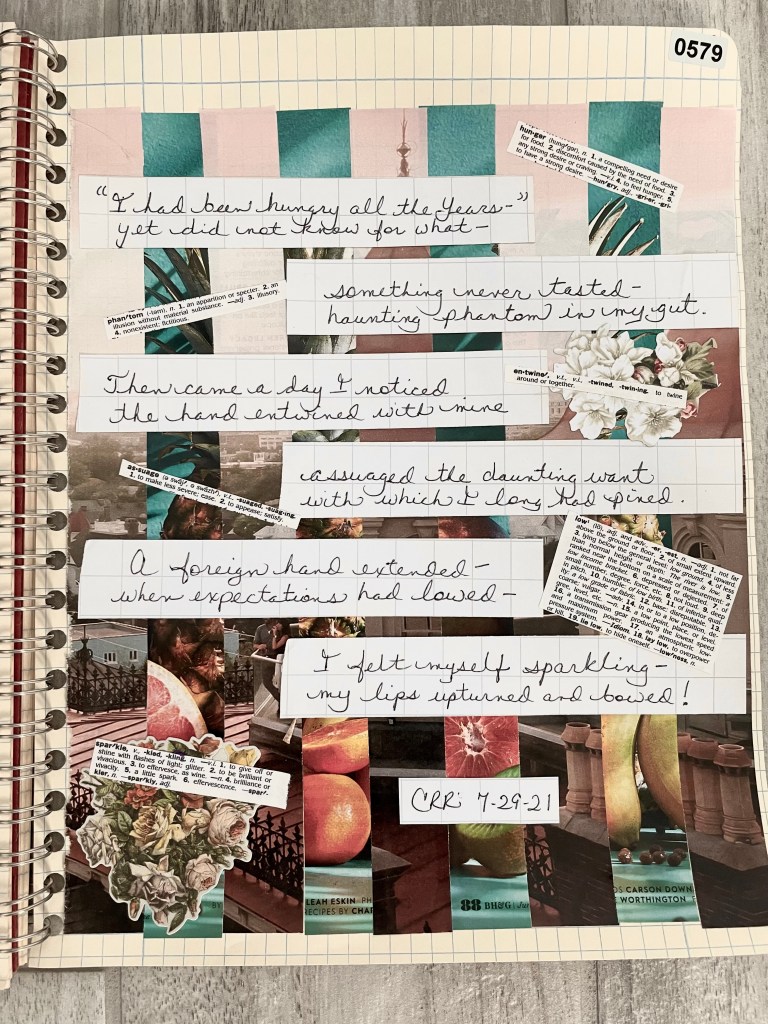
“I Had Been Hungry All The Years”

It is widely accepted that in poem #579 Emily uses food and hunger as metaphors for life. As humans we hunger for much more than food, and certainly Emily felt those same hungers. We find and try things, people, jobs, and places we think we want and later find them not to be the case. At times we can’t identify the thing that would gratify the hunger we feel, but we know what the emptiness of its absence feels like.

My journey to satiate that unidentified want ended in 2003 when I met my best friend and love in the face of a man I never would have chosen before. He wasn’t an outlaw, a (public) bad boy, or a rebel. He was everything I never knew I wanted and everything I had always needed to compliment the person I am. I literally saw myself sparkling in his azure eyes and the rest is 18 beautiful years of history. He’s my third and last husband and he loves and puts up with all of me, (even when I flip him a bird). This one’s for him. ❤

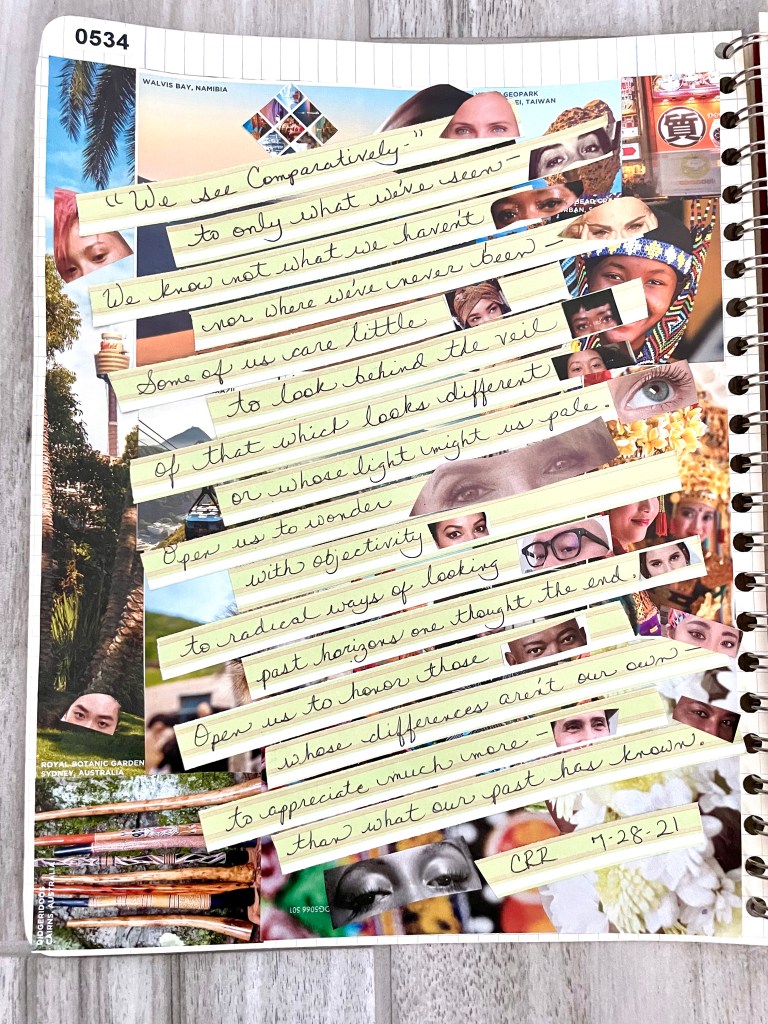
“We See Comparatively”

“We don’t see things as they are, we see things as we are.” Anais Nin

“What we see depends mainly on what we look for.” John Lubbock

The two quotes above illustrate the same idea that Emily proposed in poem #534, that we see things through our personal lenses of likeness and contrast. Not unlike now, but certainly more during her time, the opportunity to travel far was limited to those wealthy enough to do so. Today we have the whole world at our fingertips, literally, through our devices. If unable to travel, we can virtually experience a trip anywhere around the planet to view the many wonders of people, places and lifestyles foreign to us. No matter how we connect with others, we still perceive them through the lens of who we are. I wrote this because I think we all (including me) need to be reminded of that fact, and to appreciate the differences that exist in our human family without comparing them to ourselves.

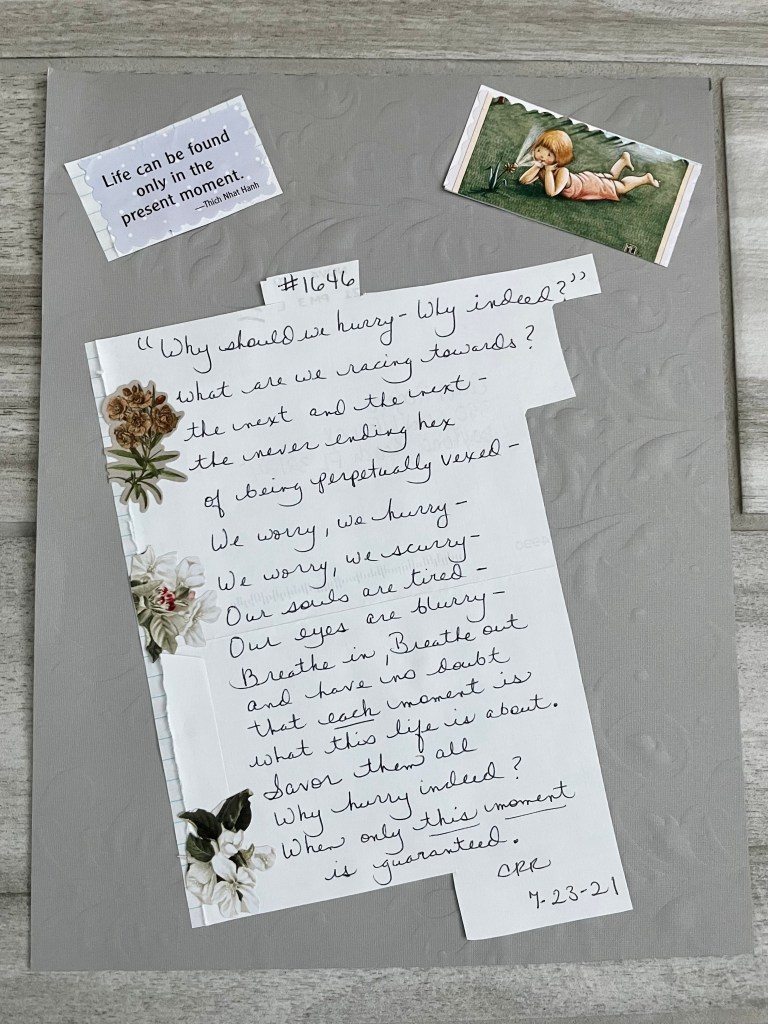
“Why Should We Hurry- Why Indeed?”

Unless you’re new to Emily Dickinson, you know that Death was never far away in her thoughts and poetry. In #1646 she speaks of being “molested by immortality” and seems to say that we’re being tricked into thinking it will all last, when nothing actually will, because everything ends, so why hurry ourselves to that dark night.

The case against hurrying is not new. The irony is that we’ve been telling ourselves to slow down since the invention of everything humans have designed to help us do more faster. The reality is that we miss so much when we hurry. Most of all we miss the opportunity for genuine connection with others, nature, and our own inner selves. And the ramifications of all of that? Staggering, massive, and negatively consequential. So let’s take a moment whenever we can and focus on living our lives a little slower, because being more mindful can only make things better for all of us.

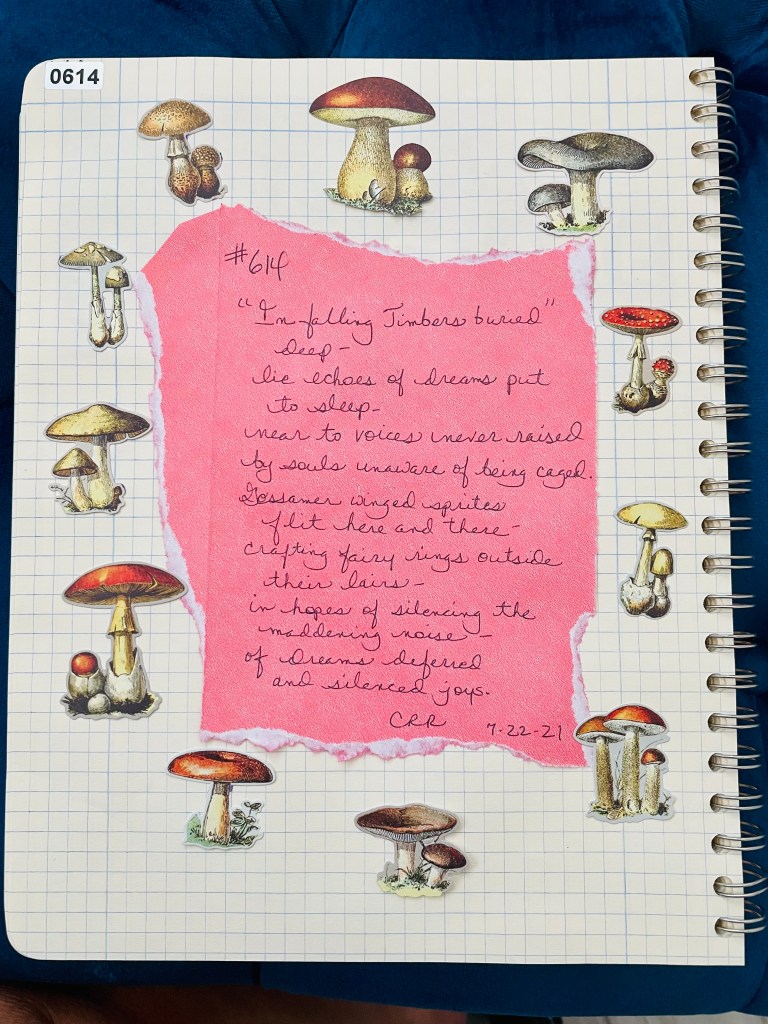
“In Falling Timbers Buried”

Some say Emily Dickinson had a morbid fascination with death. Others see the fact that approximately 1/6th of all her poems and letters were about death as something not unusual for one who lived next to a cemetery and during a time when folks died of illnesses at a much younger age than we do today. Her poem #614 speaks of diggers attempting to find a man buried in rubble. Too late, the saving grace is Death, in that he is no longer suffering.

I saw the setting of the first line of #614 as a place where dreams die, aspirations are quashed and we sometimes don’t even understand that we have made ourselves prisoners. I imagined a frolic of mythical forest fairies engaging in a battle with death, attempting to coax it into and ward it off with their fairy ring of mushrooms, a place of legendary doom for non-fairy folk.

In researching fairy rings, I learned quite a bit and will definitely be on the lookout for them in the future. If there’s a full moon and you see me running around one nine times, from east to west (the direction of the sun), it will be in hopes of hearing the fairies dancing and frolicking underground. Please just watch from afar and don’t make me lose count, for legend has it if I run around a tenth time I will meet ill fate and be made to run to the point of exhaustion and death and/or perhaps become invisible.

References

Emily Dickinson and Death – Emily Dickinson Museum

MCNAUGHTON, RUTH FLANDERS. “Emily Dickinson on Death.” Prairie Schooner, vol. 23, no. 2, 1949, pp. 203–214. JSTOR, www.jstor.org/stable/40624107. Accessed 22 July 2021.

Do you dare enter a fairy ring? The mythical mushroom portals of the supernatural | Ancient Origins (ancient-origins.net)

Magical Fairy Rings: The Science and Folklore (mushroom-appreciation.com)

the prowling Bee: In falling Timbers buried — (bloggingdickinson.blogspot.com)

Fairy ring – Wikipedia

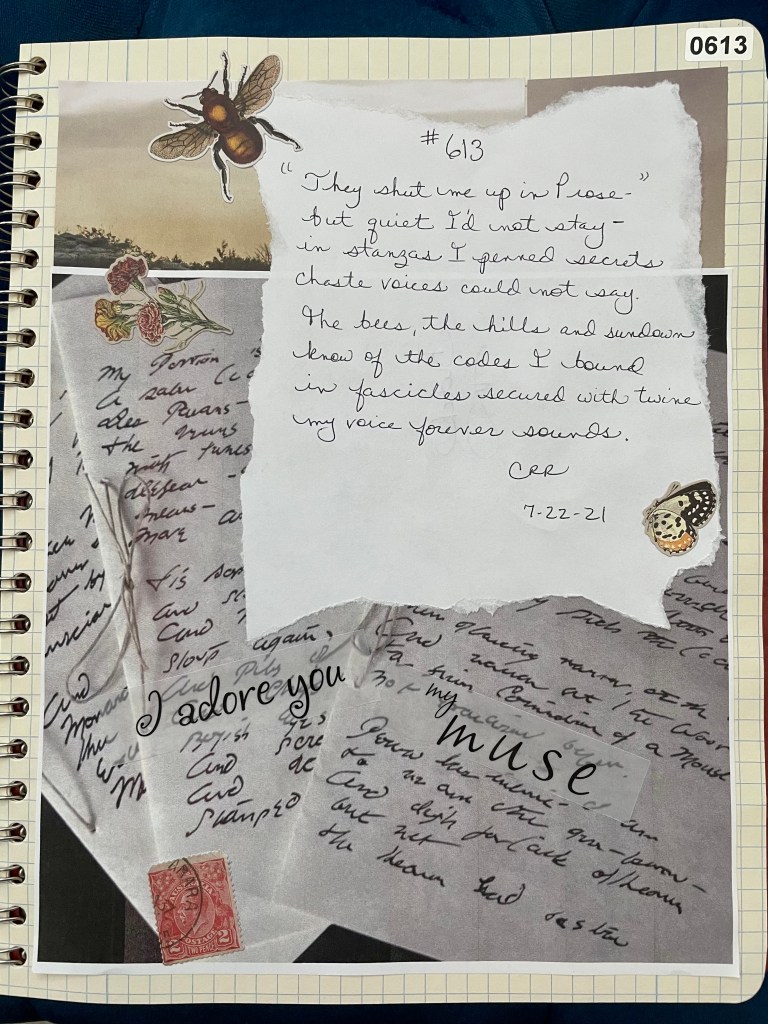
“They Shut Me Up in Prose”

According to some scholars, Dickinson’s poem #613 is quite the exercise in feminism. In it, she masterfully uses the imagery of a captive bird and speaks in a defiant voice about the struggles of being a female, expected to be silent and kept locked up by societal expectations of the mid 1800’s.

Although she never engaged in any public romantic relationships, researchers have long questioned the many cryptic references to “loves” in her poetry and posed questions about her private life and potential relationships with several men and also with her sister-in-law, Susan Huntington Gilbert Dickinson. In my version of this poem I imagine the coded language she used to send messages that would not be deemed appropriate during her time. Over a century and a half later, fans of her work are still looking for the meanings between her lines.

Note on “fascicles:

*During Dickinson’s intense writing period (1858-1864), she copied more than 800 of her poems into small booklets, forty in all, now called “fascicles.” She made the small volumes herself from folded sheets of paper that she stacked and then bound by stabbing two holes on the left side of the paper and tying the stacked sheets with string. She shared these with no one. They were discovered by her sister Lavinia after Emily’s death.

References

They shut me up in Prose (F445A, J613) – White Heat (dartmouth.edu)

1855-1865: The Writing Years – Emily Dickinson Museum