“Why Should We Hurry- Why Indeed?”

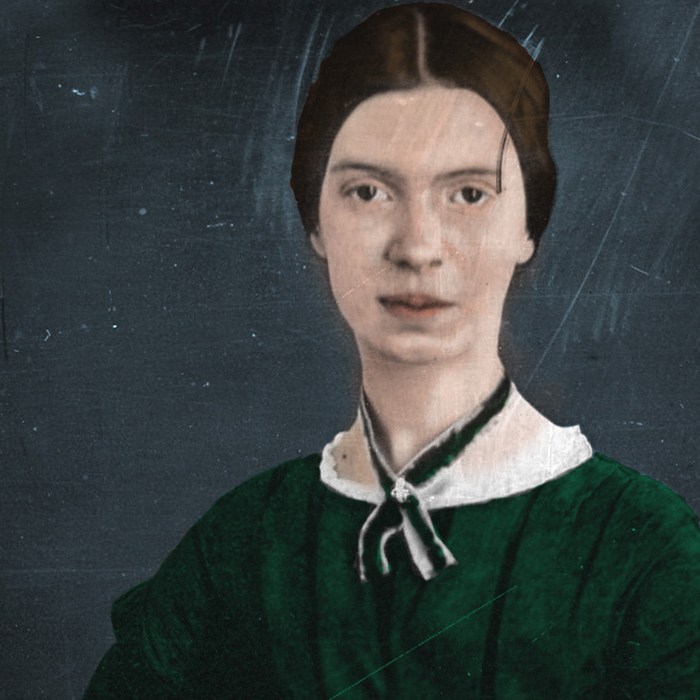
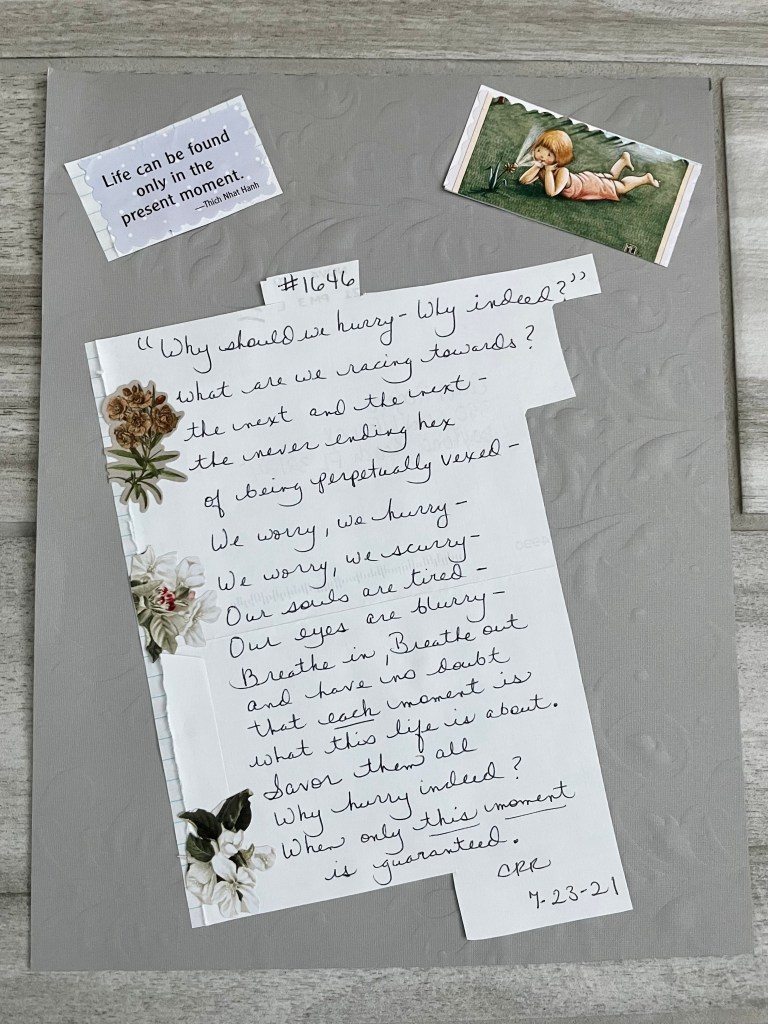
Unless you’re new to Emily Dickinson, you know that Death was never far away in her thoughts and poetry. In #1646 she speaks of being “molested by immortality” and seems to say that we’re being tricked into thinking it will all last, when nothing actually will, because everything ends, so why hurry ourselves to that dark night.

The case against hurrying is not new. The irony is that we’ve been telling ourselves to slow down since the invention of everything humans have designed to help us do more faster. The reality is that we miss so much when we hurry. Most of all we miss the opportunity for genuine connection with others, nature, and our own inner selves. And the ramifications of all of that? Staggering, massive, and negatively consequential. So let’s take a moment whenever we can and focus on living our lives a little slower, because being more mindful can only make things better for all of us.

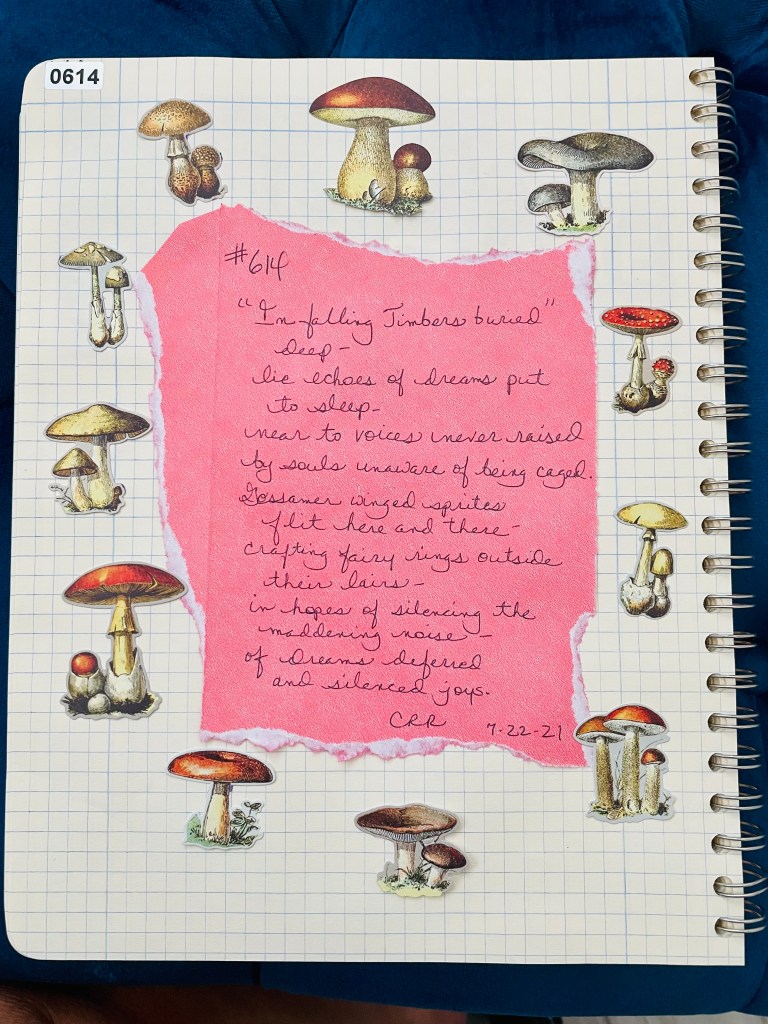
“In Falling Timbers Buried”

Some say Emily Dickinson had a morbid fascination with death. Others see the fact that approximately 1/6th of all her poems and letters were about death as something not unusual for one who lived next to a cemetery and during a time when folks died of illnesses at a much younger age than we do today. Her poem #614 speaks of diggers attempting to find a man buried in rubble. Too late, the saving grace is Death, in that he is no longer suffering.

I saw the setting of the first line of #614 as a place where dreams die, aspirations are quashed and we sometimes don’t even understand that we have made ourselves prisoners. I imagined a frolic of mythical forest fairies engaging in a battle with death, attempting to coax it into and ward it off with their fairy ring of mushrooms, a place of legendary doom for non-fairy folk.

In researching fairy rings, I learned quite a bit and will definitely be on the lookout for them in the future. If there’s a full moon and you see me running around one nine times, from east to west (the direction of the sun), it will be in hopes of hearing the fairies dancing and frolicking underground. Please just watch from afar and don’t make me lose count, for legend has it if I run around a tenth time I will meet ill fate and be made to run to the point of exhaustion and death and/or perhaps become invisible.

References

Emily Dickinson and Death – Emily Dickinson Museum

MCNAUGHTON, RUTH FLANDERS. “Emily Dickinson on Death.” Prairie Schooner, vol. 23, no. 2, 1949, pp. 203–214. JSTOR, www.jstor.org/stable/40624107. Accessed 22 July 2021.

Do you dare enter a fairy ring? The mythical mushroom portals of the supernatural | Ancient Origins (ancient-origins.net)

Magical Fairy Rings: The Science and Folklore (mushroom-appreciation.com)

the prowling Bee: In falling Timbers buried — (bloggingdickinson.blogspot.com)

Fairy ring – Wikipedia

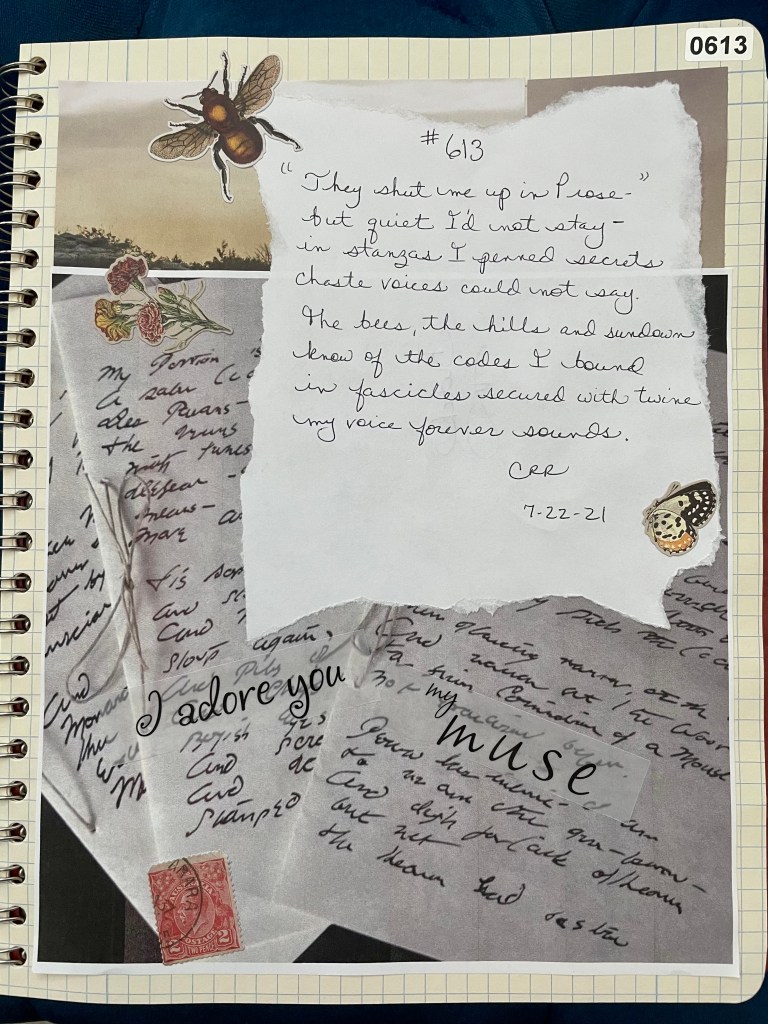
“They Shut Me Up in Prose”

According to some scholars, Dickinson’s poem #613 is quite the exercise in feminism. In it, she masterfully uses the imagery of a captive bird and speaks in a defiant voice about the struggles of being a female, expected to be silent and kept locked up by societal expectations of the mid 1800’s.

Although she never engaged in any public romantic relationships, researchers have long questioned the many cryptic references to “loves” in her poetry and posed questions about her private life and potential relationships with several men and also with her sister-in-law, Susan Huntington Gilbert Dickinson. In my version of this poem I imagine the coded language she used to send messages that would not be deemed appropriate during her time. Over a century and a half later, fans of her work are still looking for the meanings between her lines.

Note on “fascicles:

*During Dickinson’s intense writing period (1858-1864), she copied more than 800 of her poems into small booklets, forty in all, now called “fascicles.” She made the small volumes herself from folded sheets of paper that she stacked and then bound by stabbing two holes on the left side of the paper and tying the stacked sheets with string. She shared these with no one. They were discovered by her sister Lavinia after Emily’s death.

References

They shut me up in Prose (F445A, J613) – White Heat (dartmouth.edu)

1855-1865: The Writing Years – Emily Dickinson Museum

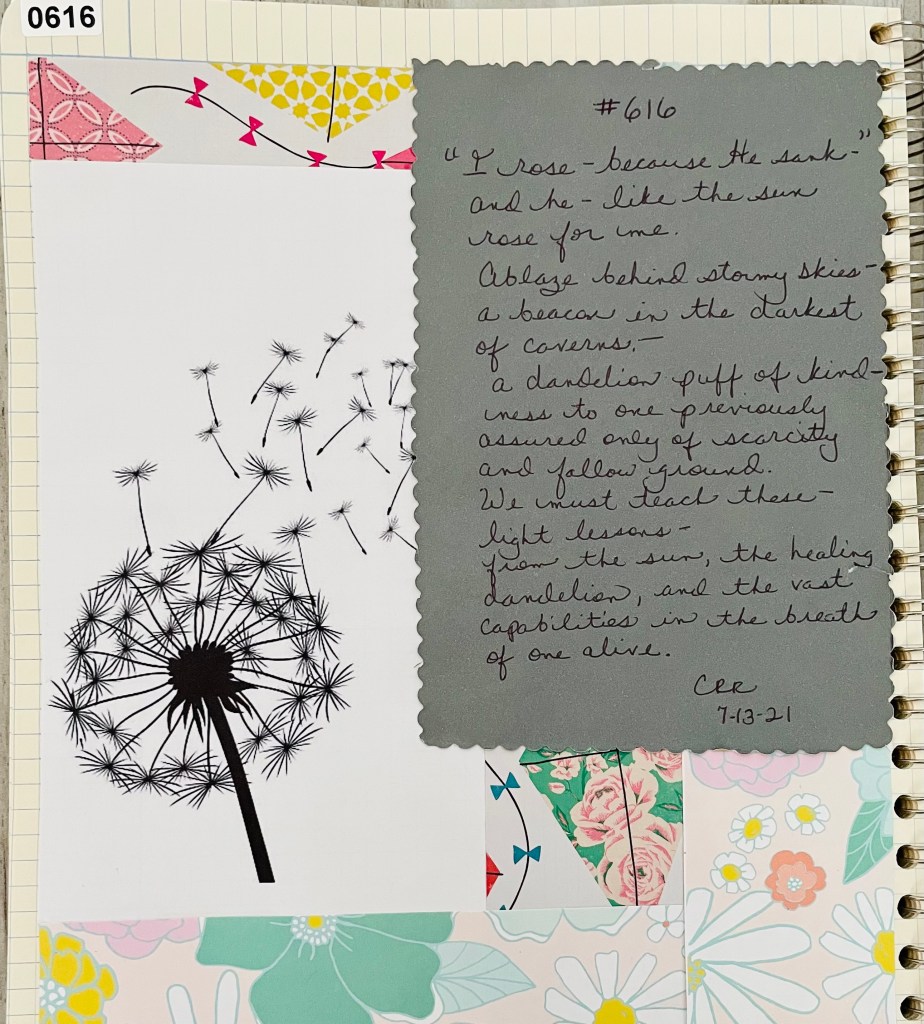
“I Rose Because He Sank”

The kindness of strangers, the devotion of one who loves or simply cares. Emily most certainly knew and exercised both herself, as have you and I. Unable to sleep any later this morning, I rose early and flipped through my catalog of first lines and chose this one. I immediately thought of all of the times others have gifted me with exactly what I was unknowingly in need of and also of those times when strangers or kind hearts have seen an obvious need and spontaneously reached out to take my hand, light my way or lighten my load. Their kindnesses served to increase the want in me to do the same.

A moment in time that would register insignificant in the chronicles of world history could be a catalyst, a lifeboat, or a key to a long locked door. We often have no idea or at least not the full extent of the impact of a small act of kindness. That’s the key to it all though, to the world being a gentler place. If we are living and breathing, if we have eyes to see or ears to detect a need, we have it in us to inspire, to educate, and to influence and affect others in a positive way. May we all rise to the occasion.

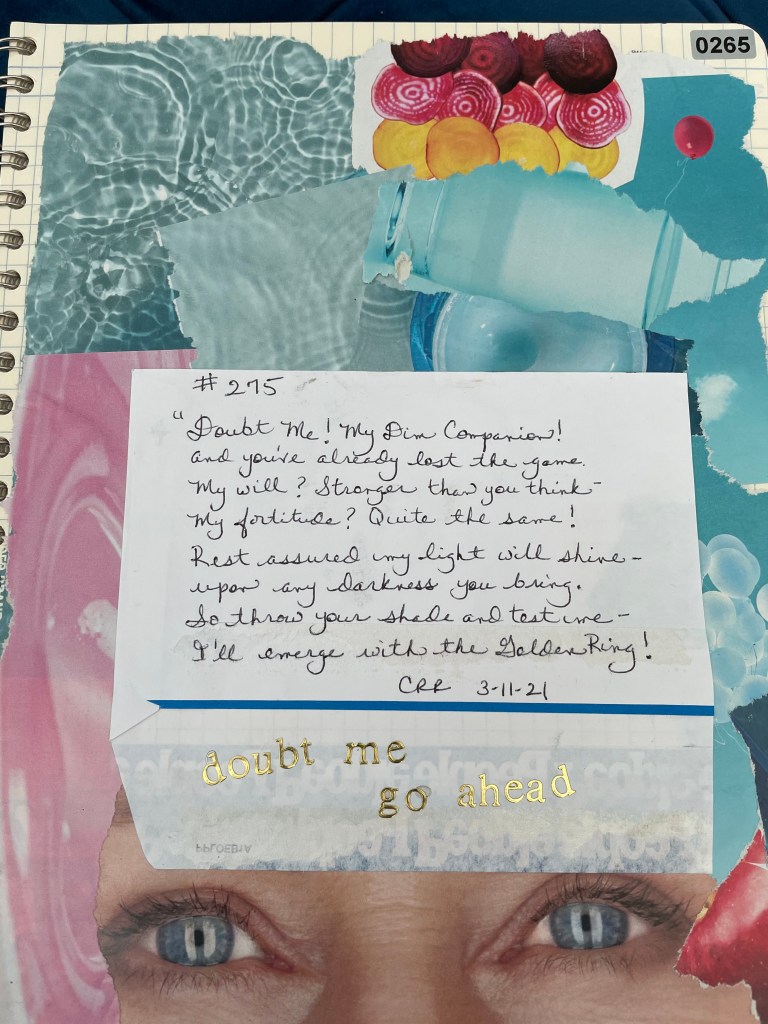
Go Ahead, Doubt Me

If you research analysis of Emily’s poem #275, you’ll find many in agreement that she is thought to be addressing a “love interest” and declaring that he should not doubt her feelings, her love for him. It’s somewhat hard for us to reconcile her speaking such words because although she maintained correspondence with several men, there is no proof that she actually consummated any of those relationships or took them any farther than the intimacy in her correspondence.

I have this thing about being doubted. I’m going to do everything in my power to show you why you shouldn’t have doubted me. A bit competitive, a bit of a rebel, I just have never liked being told I can’t compete, achieve, or do something I believe I can do. Believe me when I say there are a lot of things I can’t do anymore, or would never want to do, but you’d do well to believe that if I put my mind to something, you shouldn’t stand in my way. I hope I’ve instilled that same fight in my children and grands.

Written in a voice filled with confidence and the strength of a Mama Bear out to protect or provide for her cubs, today’s Carol and Emily poem challenges any dim companion that doesn’t heed that advice.

I Had An Idea

Like Julie and Julia. (2009 Nora Ephron). Sort of. You know, the movie, where the girl in the tiny New York apartment took a year and made it her mission to recreate each one of the 524 recipes in Julia Child’s book “Mastering the Art of French Cooking”.

Julie Powell actually started the Julie/Julia project on her blog and garnered the attention of quite a few followers, including those who offered her a book deal at Little, Brown and Company. Julia Child was reportedly unimpressed and said as much, although I think that was a little hoity-toity of her. The book led to the movie and the rest, as they say, is history.

But get to the point Carol. Your idea?

One of my first poet loves was Emily Dickinson and the very first poem I memorized was:

Im nobody.

Who are you?

Are you nobody too?

Then there’s a pair of us- don’t tell!

They’d banish us you know.

How dreary to be somebody!

How public, like a frog .

To tell your name the lifelong day

To an admiring bog!”

At 10, just as now, this particular poem seemed perfectly suited for my introverted self.

Being an admirer of Emily’s work, I thought an interesting project would be to attempt a Carol/Emily project, wherein I take the title of each of her poems and write my own, on small pieces of paper and used envelopes, just as she did. And then I remembered that Emily herself titled only a few of her 1775 poems, the others were added posthumously by editors. So much for that idea.

But what about first lines? That could be quite a challenge, given the formality of language during the 1800s, not to mention the colloquialisms of her time. But could it be a thing? I mean Dickinson on Apple TV is certainly a huge thing. I’ve binged both seasons and am suffering in wait for more.

So here we go. I mean, here I go.

New year, new challenge and all that. 1775 poems. Stay tuned. I’m sure some of it will be less than spectacular, but who knows until I try.

Emily herself said:

“Success is counted sweetest

By those who ne’er succeed

To comprehend a nectar

Requires sorest need.

Not one of all the purple Host

Who took the Flag today

Can tell the definition

So clear, of victory,

As he, defeated – dying –

On whose forbidden ear

The distant strains of triumph

Break, agonized and clear.”

Click the arrow at the top right of this page and a pull down will appear so you can subscribe if you’d like to follow along and wish me luck!

Click the arrow below to read past posts or check out the archives by clicking on the arrow top right and then looking to the left.

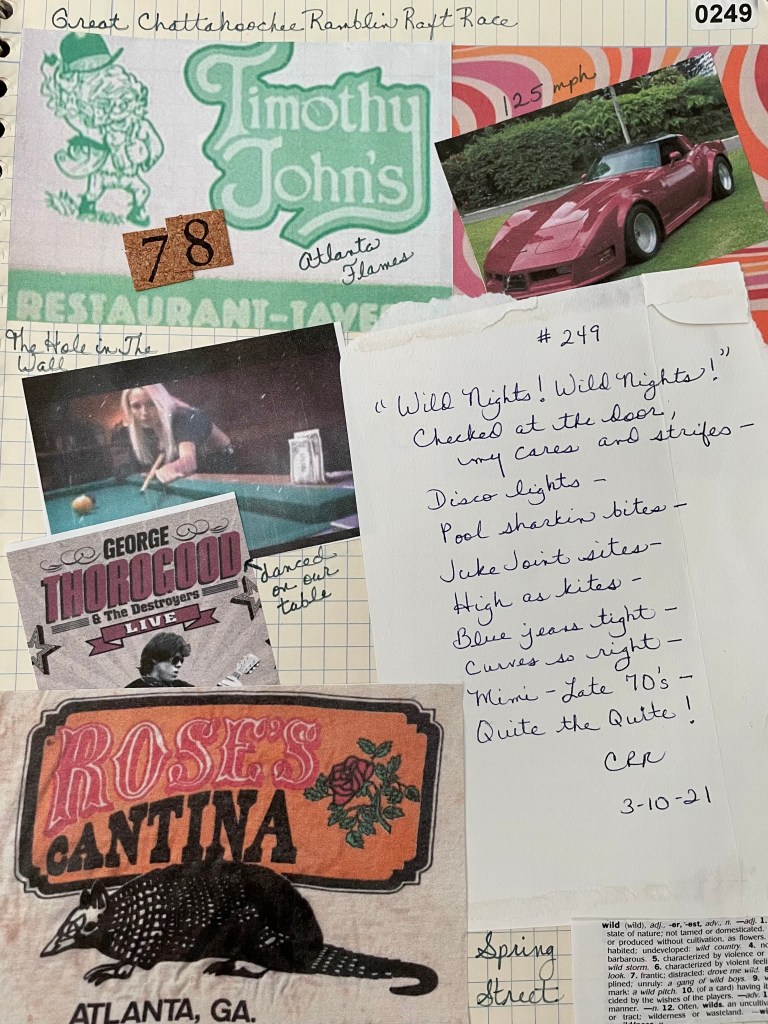
Wild Nights

I share one poem per blog post, but I’ve written many more. The lucky agent/publisher who decides I’m a good fit for their press will get to read all of the poems I’ve written with Emily’s first lines for this project! This morning I wrote about childhood memories in my grandparent’s attic bedroom, the interdependence of all living things, the hate I have for the scale at this point of my life, a certain type of friend we need and this one, about wild nights.

If Emily’s poem had truly been about a wild night she had or one she was desirous of, the mid 1800’s world she lived in would be “pull out the smelling salts” shocked. Ladies of that time period didn’t speak of such things. Hell, they weren’t even supposed to feel such things! Of course we don’t know if anyone actually did read it before her death, but even today it’s difficult to reconcile the reclusive poet to a such a passionate plea for wild nights with an unidentified lover. But who knows…

Now I may be a woman of a certain age with grown children and grandkids, but back in the late 70’s, (when I may not have always used the best judgement), I was nevertheless “Quite the Quite!

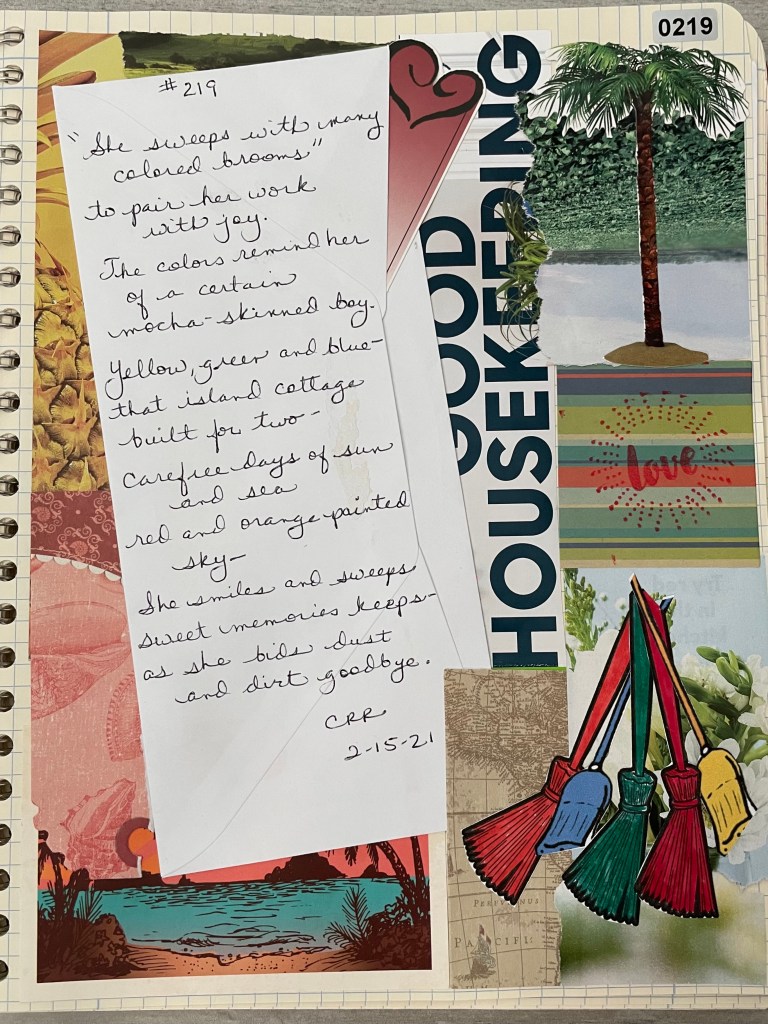
Sweeping With Many Colored Brooms

Although she isn’t here to verify it, if you Google poem 219, every analysis points to Emily Dickinson describing a sweeping multicolored sunset and referring to it as a housewife. She began the poem with a figurative first line. I took the opposite approach and quite literally made it a simple and sweet poem, about a woman, going about her daily chores with colored objects that remind her of a loved one, lost long ago. The different colors of the brooms remind her of specific things about their life together. A life that existed in the past, but one that she remembers fondly.

We all have objects, places, songs, as well as colors, scents and foods that remind us of someone we loved. Just seeing, hearing, or tasting them brings the moments we shared with them back to life in our minds. In today’s Carol and Emily poem, I was reminded of the fact that there is dignity in all work, and that we can choose to do even the most mundane tasks with utmost effort, pride and joy, focusing on whatever it is that makes us whistle while we work and bid that dust and dirt goodbye.

I Stole Them From A Bee

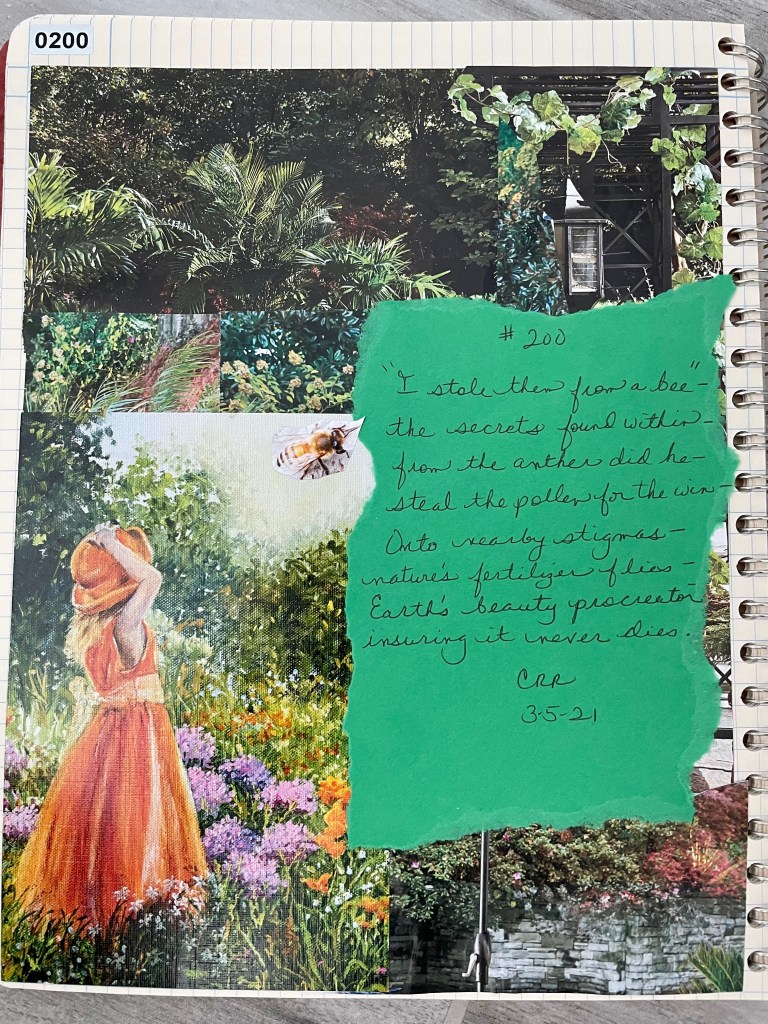
According to the Emily Dickinson Archive, there are 280 instances of bees in poems written by her. There is plenty of analysis out there regarding her personification of bees and flowers etc. and how it speaks of gender conventions, religion and eroticism, but that’s not what this blog is about. It’s widely accepted that she loved nature and spent quite a lot of time by herself in it, thus why so many of her poems contain references to the natural world. Emily no doubt knew of the bee’s importance in contributing to biodiversity, creating a food source, and as pollinators facilitating wild plant growth. Bees are also said to pollinate one-third of the global food supply, more than 90 different agricultural crops.

Like Emily, I find great beauty and solace in nature. It has many valuable lessons and secrets to teach us if we take the time to observe the cycles, habits, and behaviors of other living things. One might surmise that Emily preferred the natural world over human beings, especially toward the end of her life when she became more reclusive. I submit that she sincerely appreciated the contributions of the natural world to the beauty of our planet and took the time to write about it.

  • References- Emily Dickinson Archive
  • Eating Well Magazine, Mar.2021

On Kindness

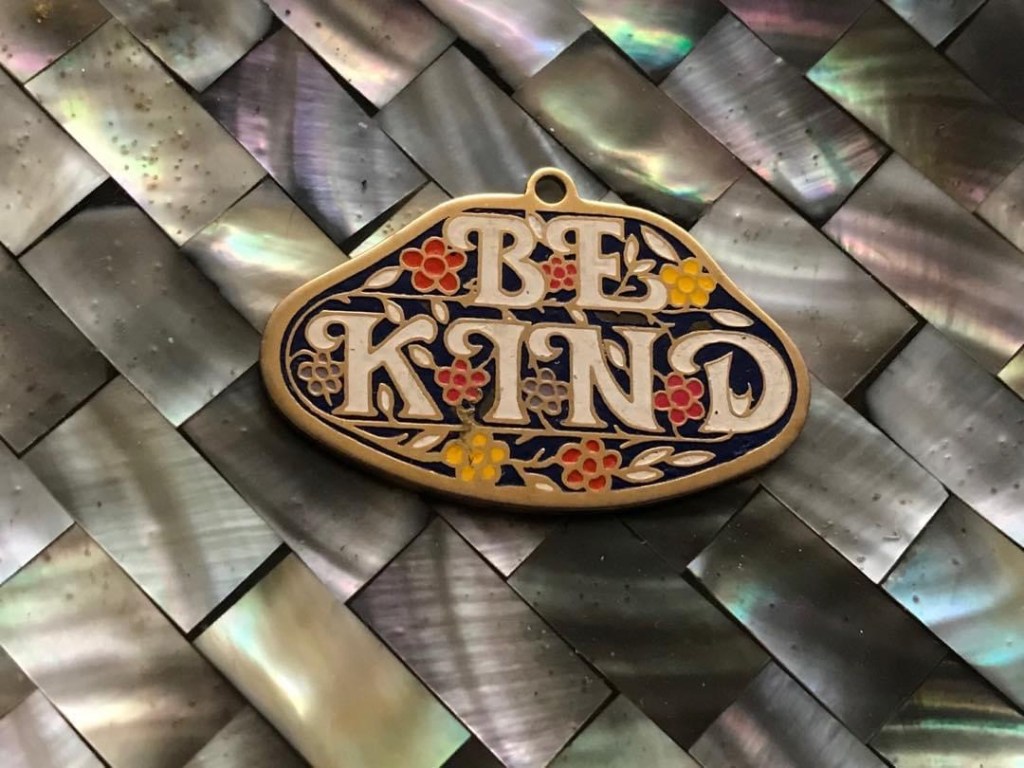
This photo came up as a serendipitous Facebook memory this morning. Serendipitous because I just finished a poem about kindness yesterday, with the intent of posting it today. This “Be Kind” pendant is one of the few relics I have from my teenage years. Three years ago I found it in a box of memories. Although it’s nearly 50 years old, its message is timeless. I remember buying it at The Infinite Mushroom, a really cool head shop in Orlando in the early 70s. It was where every teen went to get their black light posters, ultra-cool clothes/accessories, and of course the other things that made it a “head shop”.

Emily often sent poems as part of her letters or accompanying them, to family, friends and acquaintances. She wrote the first line of this poem in a letter to Samuel Bowles in August of 1858. Bowles was the Editor-In-Chief of the Springfield Republican newspaper. Over the years he became Emily’s confidant and would receive 40 poems in letters from her, but publish none of them. Seven of her poems were published in his paper during her lifetime, but the specifics of how they came to be published remain unknown. 

Despite all the goodness and good people that are out there making the world a kinder place every day, today’s Carol and Emily poem recognizes the still ever present need for a “Kindness Revolution”. Because you can never have too much kindness or spread too much love.

References  emilydickinsonmuseum.org