I Had An Idea

Like Julie and Julia. (2009 Nora Ephron). Sort of. You know, the movie, where the girl in the tiny New York apartment took a year and made it her mission to recreate each one of the 524 recipes in Julia Child’s book “Mastering the Art of French Cooking”.

Julie Powell actually started the Julie/Julia project on her blog and garnered the attention of quite a few followers, including those who offered her a book deal at Little, Brown and Company. Julia Child was reportedly unimpressed and said as much, although I think that was a little hoity-toity of her. The book led to the movie and the rest, as they say, is history.

But get to the point Carol. Your idea?

One of my first poet loves was Emily Dickinson and the very first poem I memorized was:

Im nobody.

Who are you?

Are you nobody too?

Then there’s a pair of us- don’t tell!

They’d banish us you know.

How dreary to be somebody!

How public, like a frog .

To tell your name the lifelong day

To an admiring bog!”

At 10, just as now, this particular poem seemed perfectly suited for my introverted self.

Being an admirer of Emily’s work, I thought an interesting project would be to attempt a Carol/Emily project, wherein I take the title of each of her poems and write my own, on small pieces of paper and used envelopes, just as she did. And then I remembered that Emily herself titled only a few of her 1775 poems, the others were added posthumously by editors. So much for that idea.

But what about first lines? That could be quite a challenge, given the formality of language during the 1800s, not to mention the colloquialisms of her time. But could it be a thing? I mean Dickinson on Apple TV is certainly a huge thing. I’ve binged both seasons and am suffering in wait for more.

So here we go. I mean, here I go.

New year, new challenge and all that. 1775 poems. Stay tuned. I’m sure some of it will be less than spectacular, but who knows until I try.

Emily herself said:

“Success is counted sweetest

By those who ne’er succeed

To comprehend a nectar

Requires sorest need.

Not one of all the purple Host

Who took the Flag today

Can tell the definition

So clear, of victory,

As he, defeated – dying –

On whose forbidden ear

The distant strains of triumph

Break, agonized and clear.”
Click the arrow at the top right of this page and a pull down will appear so you can subscribe if you’d like to follow along and wish me luck!

Click the arrow below to read past posts or check out the archives by clicking on the arrow top right and then looking to the left.

Herstory

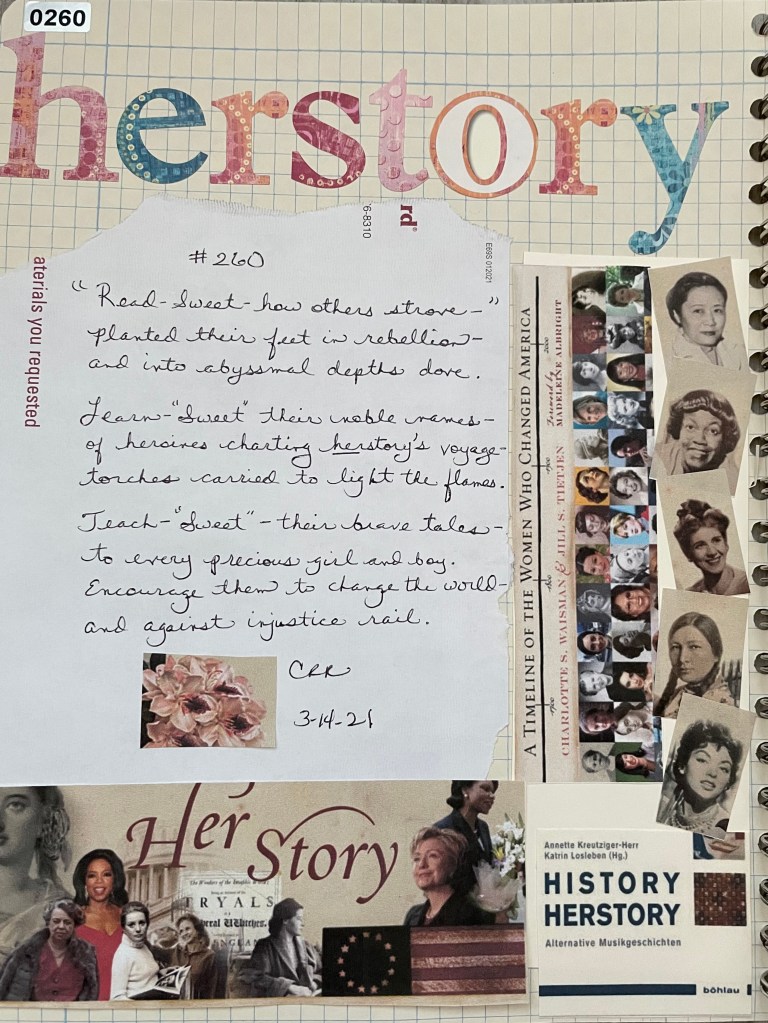
Emily Dickinson lived and wrote in a society that cordoned women into one very traditional role, that of housewife, mother and helpmate to her husband. She rebelled against this tradition by simply doing her own thing and using her words to exercise her will. The majority of those words would go unpublished until after her death, when she would posthumously be recognized as one of the world’s greatest poets. She would not live to see white women be given the right to vote in 1920, but she did live through the years during which the suffrage movement developed and the NWSA, National Women’s Suffrage Movement was formed by Elizabeth Cady Stanton and Susan B. Anthony in 1869,when they formally requested that women be granted suffrage and the right to be heard on the floor of Congress. Although not a voice for political change within her lifetime, scholars have noted that her words included many nods to feminism, along with the fact that her own life and the style in which she wrote was a rebellion against the status-quo of her times.

Slate.com answered the question, “Is History written by men about men?”, in their 2015 study of 614 History trade books published during that year. The answer was yes. 75.7 percent of the books they surveyed were written by males and 71.7 percent of the biographies were about male subjects. Only during my own lifetime have the contributions of women begun to be recognized and long overdue credit given. So yes, we have more female voices being heard today and we even have the first female Vice President, but when 172 Republican members of our Congressional House voted against reauthorizing the Violence Against Women Act on Wednesday, we know that there is still much work to be done in the area of equality. There are still many battles to be fought, many women’s previously and currently silenced voices to be heard, and many new chapters to be penned in the Herstory of our country and our world.

My Carol and Emily poem is a plea for us all to read, learn and teach the next generation both the Herstory and the History of our world and to rally against injustice in any form.

References

Letter to Congress from Elizabeth Cady Stanton, Susan B. Anthony and Others in Support of Women’s Suffrage | DocsTeach

“Feminism of Emily Dickinson.” ukessays.com. 11 2018. UKEssays. 03 2021 https://www.ukessays.com/essays/english-literature/feminism-of-emily-dickinson.php?vref=1.

House votes to reauthorize landmark Violenace Against Women Act – The Washington Post

emilydickinsonmuseum.org

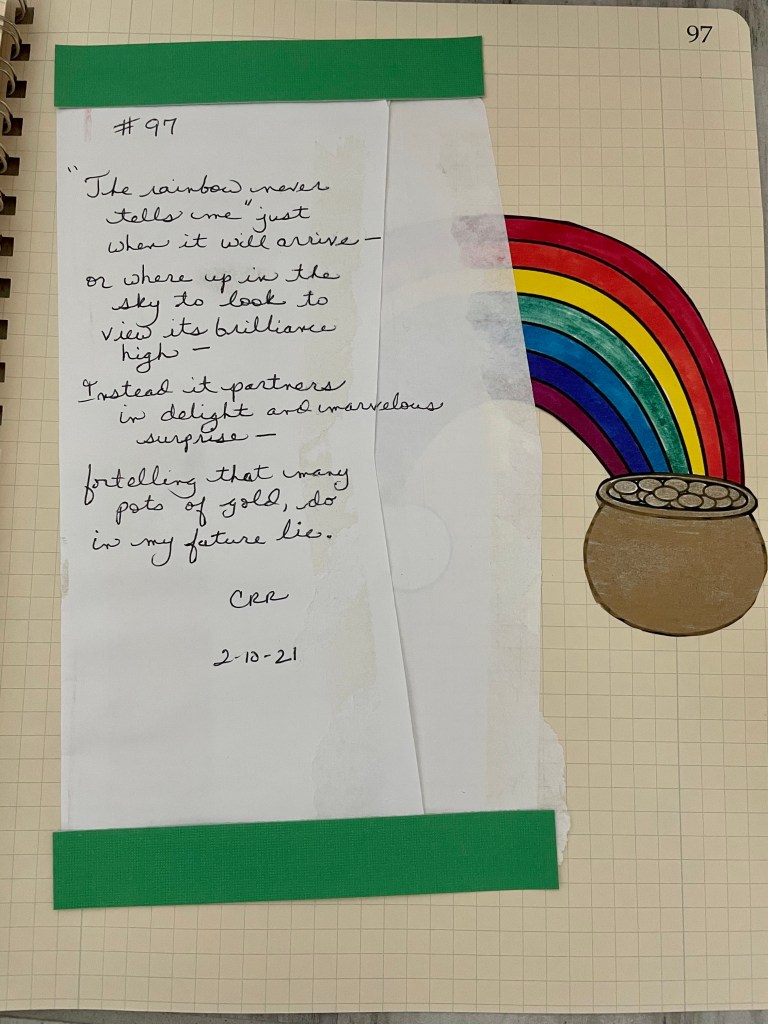
Pots of Gold

I’ll just say it right off. The “artwork” for today’s poem is clearly lacking, so much so, that I hesitated to share this one. I realize I didn’t hit the jackpot in terms of my creativity when it comes to making art, but I still try to give it my best shot. Apparently, on February 10th when I penned it, this was my best. LOL! Anyway, since it’s St. Patrick’s Day, I thought it timely to share.

When I was still working on my degree and my children were little, I wrote a story for the Children’s Lit class I was taking. In my story, a family notices a rainbow in the sky after a rain. The children question whether they can all go out and follow it, to find the end and the pot of gold. The mom and dad agree and off they go on a fun adventure to follow the rainbow to its end. As the story wraps up, they find themselves in the middle of their own back yard, where together they realize that “they” are the pot of gold they’d been searching for. And how true that is! Our loved ones are own personal pots of gold that no amount of money or gold could replace.

Today’s Carol and Emily poem is a simple one of hope and belief, that in the appearance of a beautiful rainbow, lies proof that life is good and many wonderful things are still to come.

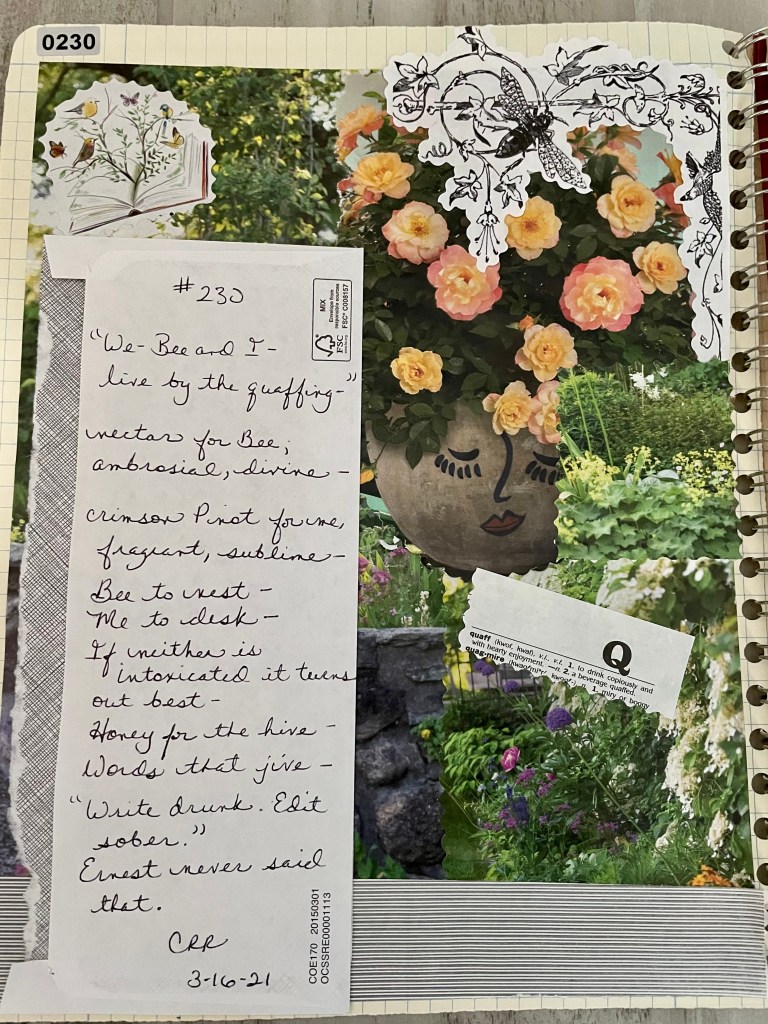
Who Knew Bees Could Get Drunk?

I didn’t. It’s something I never considered , because why would you? But indeed, bees can get drunk on fermented nectar. A drunk bee acts much the same as a drunk person, dazed, confused and unable to fly. Arrests for Public drunkenness were often reported in the newspapers during Emily Dickinson’s time, but there is no documentation of Emily partaking in the drinking of alcohol. Rather her words tell us again and again that she gets intoxicated by nature. I can definitely relate. I often find myself taken aback, delightfully stunned, my whole soul brandy soaked in the beauty, natural wonders and marvels of our world.

The quote “Write drunk, edit sober” has been misattributed to Ernest Hemingway but according to Quote Investigator, there seems to be no evidence that he ever said that. Hemingway was known to drink often, but he wrote in the mornings and did not drink until the afternoon. Speaking of drinking, for today’s Carol and Emily poem, I had to look up the word “quaffing”. The Oxford Dictionary tell us that it means “drink (something, especially an alcoholic drink) heartily.” Not unlike Hemingway, I have been known to drink heartily from time to time, but definitely not when writing. It doesn’t work for the bee, who can’t find her way back to her nest or is rejected by the other bees if she does, and it doesn’t bode well for me if I want to make any sense.

Maybe like me, you learned something new today. With Spring just 4 days away, perhaps like me, you plan on going outside and getting intoxicated by nature. Until next time…

References:

Drunk bees? | Can bees really get drunk? | Perth Honey Company

Write Drunk, Revise Sober – Quote Investigator

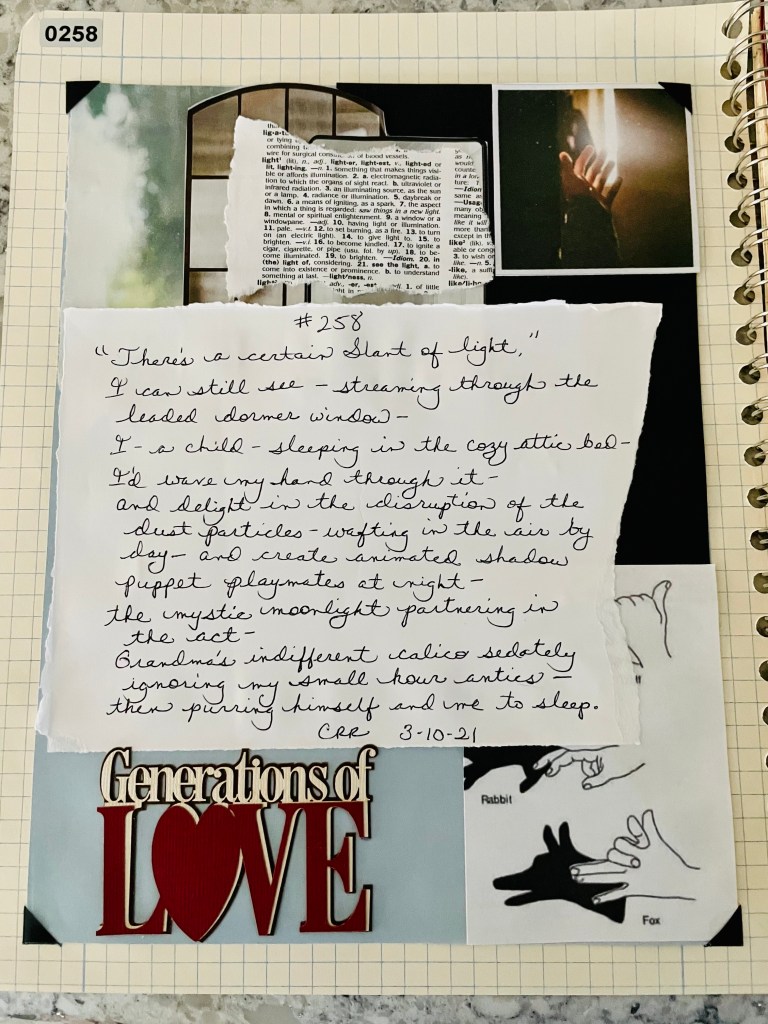
A Slant Of Light

Light carries so much symbolism, with our greatest source of it, the Sun, being one of the two things that all of life on our planet depends on. It illuminates and nourishes and without it, from plants to humans, life would quickly die off. In Emily’s poem, she used multiple literary devices and has the unknown speaker addressing the themes of despair, religion, nature, truth and transformation, all emanating from a certain slant of light streaming in or through. My poem is definitely less ambiguous and uncomplicated. It’s a nostalgic poem that I wrote by traveling in my mind back more than half a century. Well, that makes me sound ancient, doesn’t it! LOL

I have the fondest memories of sleeping in the attic bedroom at my maternal grandparent’s home in Virginia. Growing up, I spent most weekends and school vacations there. Beginning in 1946, my mother and her 3 sisters shared that room from the time the youngest was 2 until each one of them got married. I was born into that house and spent the first 22 months of my life there. Filled with memories, both literally and figuratively, it was a sweet haven that brought me lots of joy.

I’ve lived in a lot of places since then, (and I do mean a lot- 34 houses/apartments in my lifetime) but that house, my first home, I can still see it today in amazing Kodachrome detail. The smells, the sounds, the tastes, all like it was yesterday in my mind. The black and white parquet kitchen floor and the red table, where everything served tasted like love. The exact way the screen door sounded whenever anyone came in or went out. The white muslin cloth that was draped over the butter, sugar bowl and condiments that stayed there in between meals. Grandma standing by the woodstove, cooking Chicken Pot Pie or venison she or Pappy had hunted. Swinging on the porch swing with my Aunt Lou. Playing on Pappy’s car lift or rolling around on the garage creeper. Getting happy dirty and washing my hands in the garage sink with Gojo. Feeling safe and loved under Grandma’s quilts in the cozy attic bedroom my own mother grew up in. Being proud when I was finally big enough to go to the hen house by myself and get the eggs for breakfast. Digging potatoes in the garden and being sent down to the earthy cool root cellar for vegetables, pickles or sauces that had been canned and put up for the winter. Snapping beans, making butter, and enjoying a cool slice of sweet watermelon or hand churned ice cream outside on a hot summer day. Although my grandparents are both gone now and the house looked nothing like it used to when I drove by it 10 years ago, until their deaths it was the one place on Earth that stayed constant in my life, when it seemed like almost nothing else did. It always felt like my true home.

Perhaps this brought back some of your own memories of growing up. Hopefully you all have a place like this that you remember fondly.

References

https://www.litcharts.com/poetry/emily-dickinson/there-s-a-certain-slant-of-light

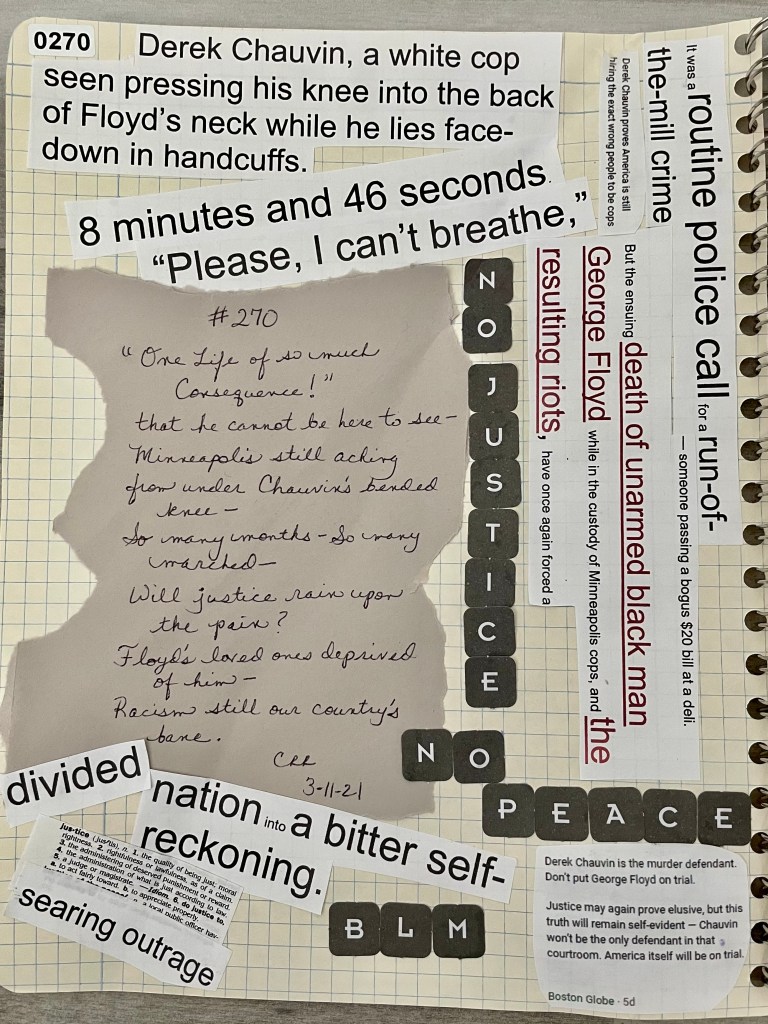
One Life

I commented about self-censoring on another poet’s post today. He had admitted being hesitant to hit the publish button on a certain post of his. We writers engage in a lot of self talk, especially when the subject matter we take on is sensitive, political, controversial, etc., etc. There’s the innate need for us to create the work, to write the words, to say the things, and then there’s the need for an audience, if we actually choose to publish our work. And the audience is a huge gamble we have to be willing to take.

Dear Readers, I have to admit that I am not a Dickinson scholar, although that is now one of my goals, and something I’m working at daily. When I choose a first line of hers to use as a prompt, my process is that I write my poem and then go back and research analyses of hers, to perhaps see how my poem’s theme relates to the body of her work. The question for this poem was “Did Emily ever address current events?” The answer, like her work is elliptical and cloaked.

Emily Dickinson was most prolific during the years of the Civil War. Scholars have deemed a small group of her poems, “War Poems”. But unlike the other “Titan of American Poetry” – Walt Whitman, she told her war stories “slant”, working around the truth, and indirectly leading you to the center of it, gradually. That’s not what I did with this poem though.

My take on #270 is very timely, as the jury selection is presently occurring in Minneapolis, Minnesota, for the Derek Chauvin trial for the murder of George Floyd. “One life of so much consequence” could absolutely have been written in another vein, about Derek Chauvin. I had a conversation with myself about posting it here. But as I wrote this poem, I was also reminded about how each one of us is a “life of so much consequence”. We touch so many others every day. The Butterfly Effects of our words and our actions are often monumental and far reaching, through generations and miles. We would do well to remember that.

References –
Walt Whitman, Emily Dickinson and the War That Changed Poetry, Forever | At the Smithsonian | Smithsonian Magazine

Boston Globe

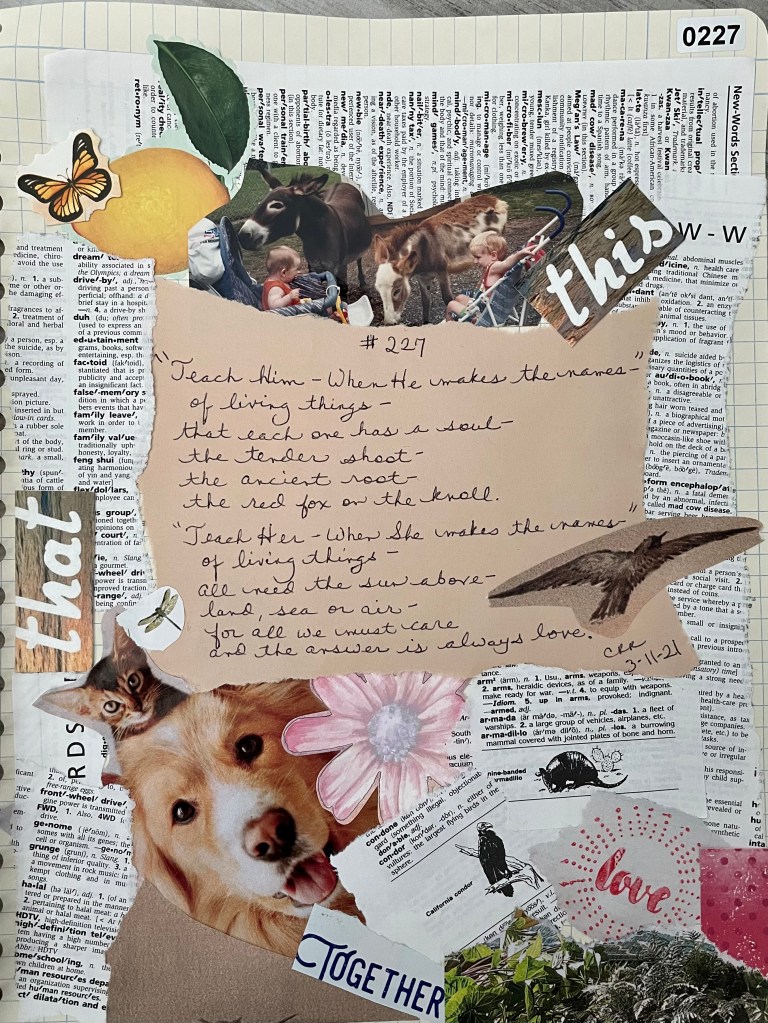
Teach Them

Today’s share is short and sweet. It’s a poem about teaching children the interdependence of all life on Earth. As we teach them the names of living things, we are hopefully teaching them about our relationship to them, theirs to each other, and the unique place each occupies in the web of life. As the renowned Italian Educator Maria Montessori taught, each living thing has a “cosmic task”, a reason for being. When we fully understand that, we can be the caretakers that we are called to be, of the environment and all of its inhabitants.

And yes, the answer is always love. ❤

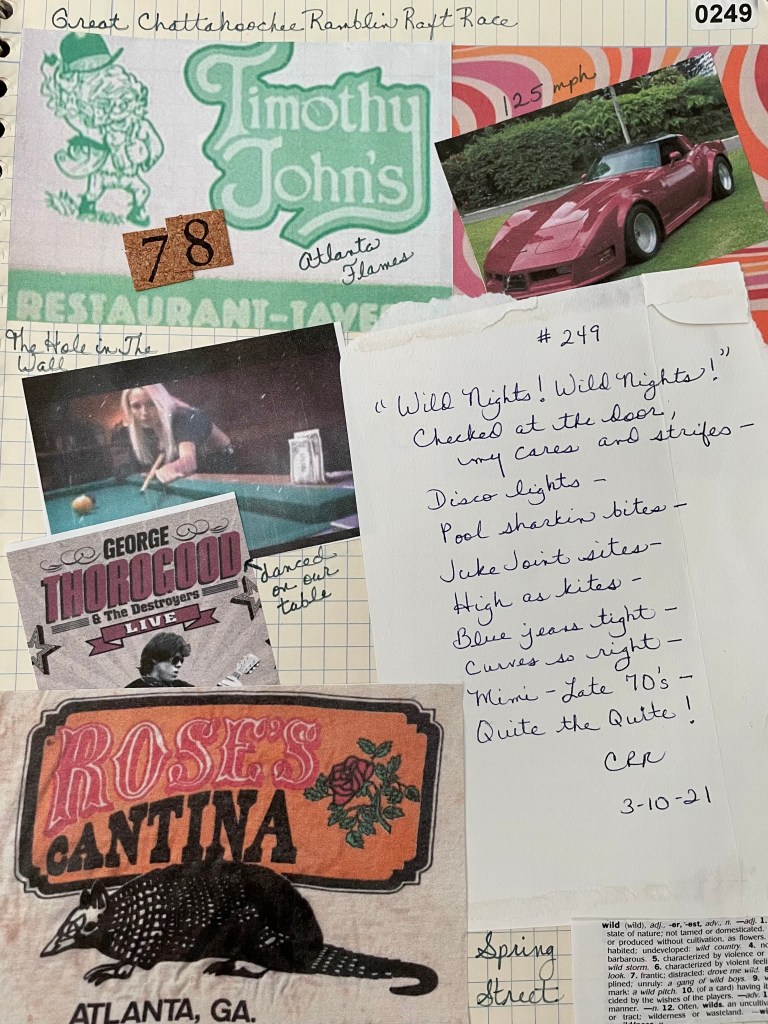
Wild Nights

I share one poem per blog post, but I’ve written many more. The lucky agent/publisher who decides I’m a good fit for their press will get to read all of the poems I’ve written with Emily’s first lines for this project! This morning I wrote about childhood memories in my grandparent’s attic bedroom, the interdependence of all living things, the hate I have for the scale at this point of my life, a certain type of friend we need and this one, about wild nights.

If Emily’s poem had truly been about a wild night she had or one she was desirous of, the mid 1800’s world she lived in would be “pull out the smelling salts” shocked. Ladies of that time period didn’t speak of such things. Hell, they weren’t even supposed to feel such things! Of course we don’t know if anyone actually did read it before her death, but even today it’s difficult to reconcile the reclusive poet to a such a passionate plea for wild nights with an unidentified lover. But who knows…

Now I may be a woman of a certain age with grown children and grandkids, but back in the late 70’s, (when I may not have always used the best judgement), I was nevertheless “Quite the Quite!

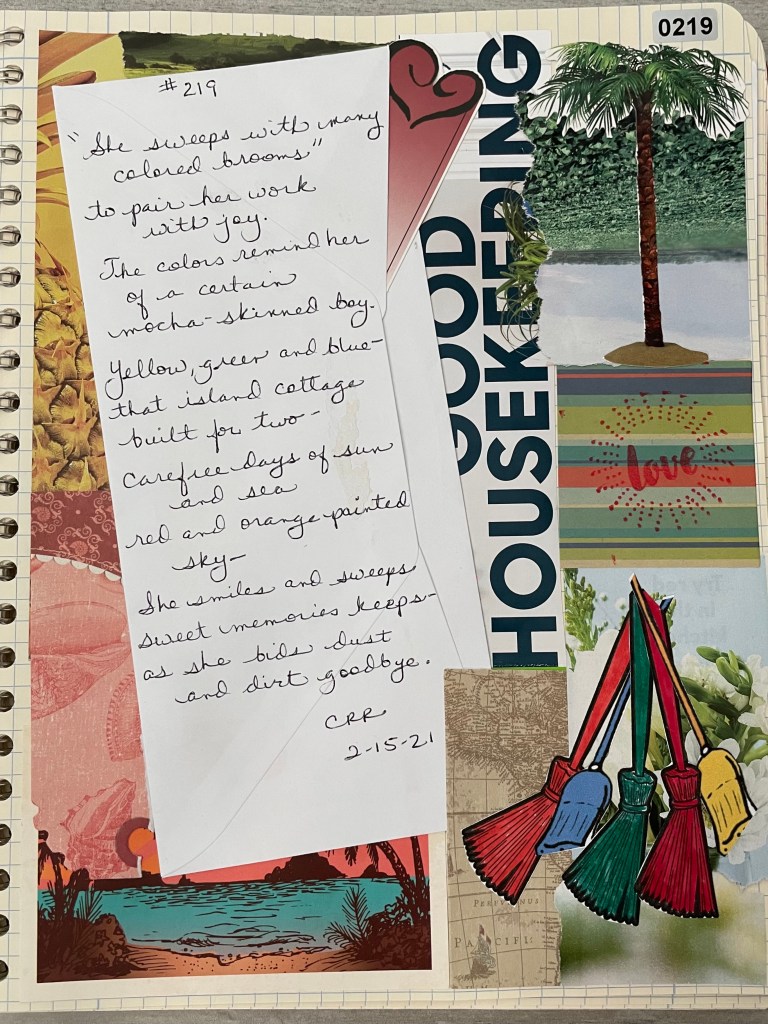
Sweeping With Many Colored Brooms

Although she isn’t here to verify it, if you Google poem 219, every analysis points to Emily Dickinson describing a sweeping multicolored sunset and referring to it as a housewife. She began the poem with a figurative first line. I took the opposite approach and quite literally made it a simple and sweet poem, about a woman, going about her daily chores with colored objects that remind her of a loved one, lost long ago. The different colors of the brooms remind her of specific things about their life together. A life that existed in the past, but one that she remembers fondly.

We all have objects, places, songs, as well as colors, scents and foods that remind us of someone we loved. Just seeing, hearing, or tasting them brings the moments we shared with them back to life in our minds. In today’s Carol and Emily poem, I was reminded of the fact that there is dignity in all work, and that we can choose to do even the most mundane tasks with utmost effort, pride and joy, focusing on whatever it is that makes us whistle while we work and bid that dust and dirt goodbye.

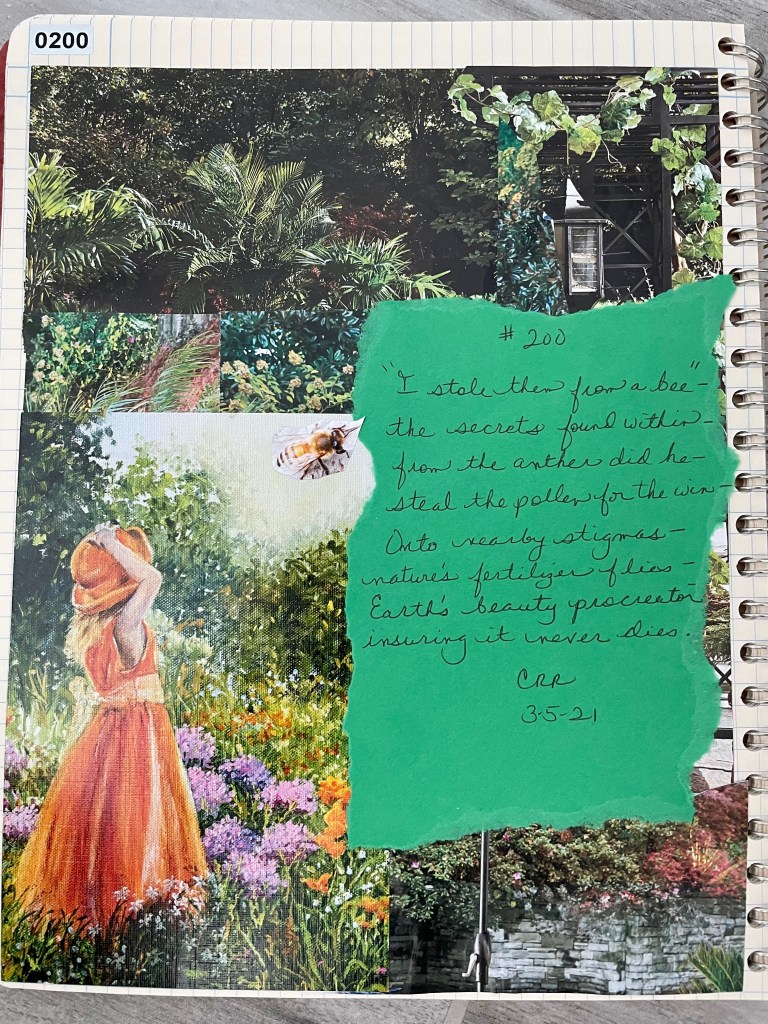
I Stole Them From A Bee

According to the Emily Dickinson Archive, there are 280 instances of bees in poems written by her. There is plenty of analysis out there regarding her personification of bees and flowers etc. and how it speaks of gender conventions, religion and eroticism, but that’s not what this blog is about. It’s widely accepted that she loved nature and spent quite a lot of time by herself in it, thus why so many of her poems contain references to the natural world. Emily no doubt knew of the bee’s importance in contributing to biodiversity, creating a food source, and as pollinators facilitating wild plant growth. Bees are also said to pollinate one-third of the global food supply, more than 90 different agricultural crops.

Like Emily, I find great beauty and solace in nature. It has many valuable lessons and secrets to teach us if we take the time to observe the cycles, habits, and behaviors of other living things. One might surmise that Emily preferred the natural world over human beings, especially toward the end of her life when she became more reclusive. I submit that she sincerely appreciated the contributions of the natural world to the beauty of our planet and took the time to write about it.

  • References- Emily Dickinson Archive
  • Eating Well Magazine, Mar.2021