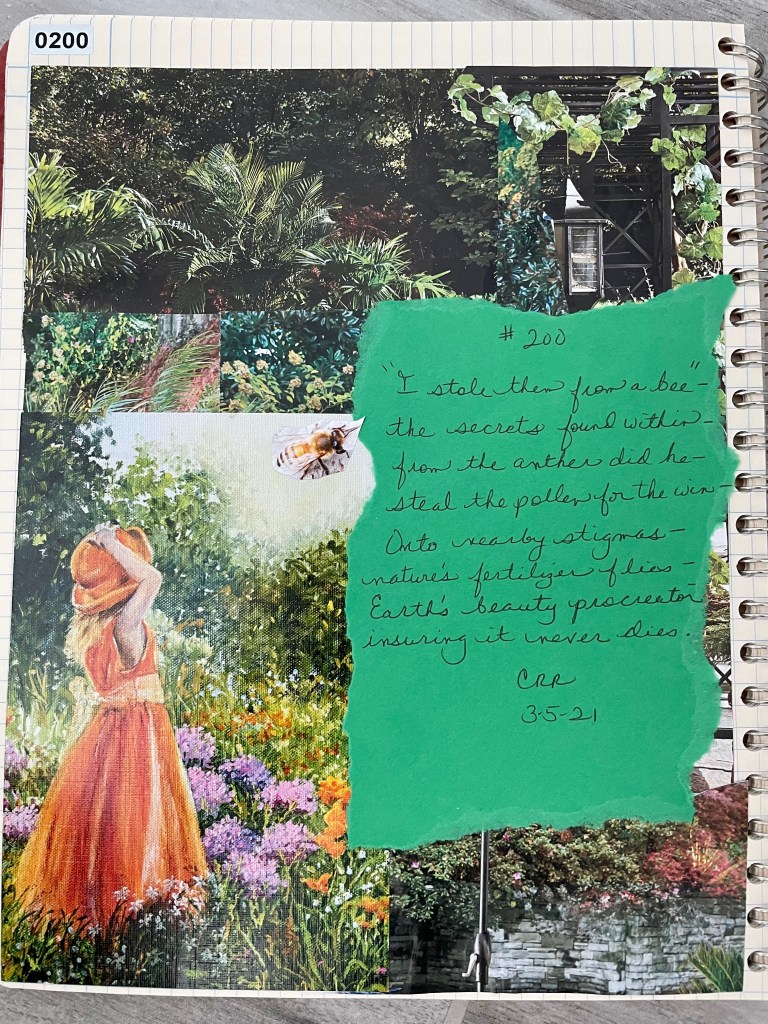
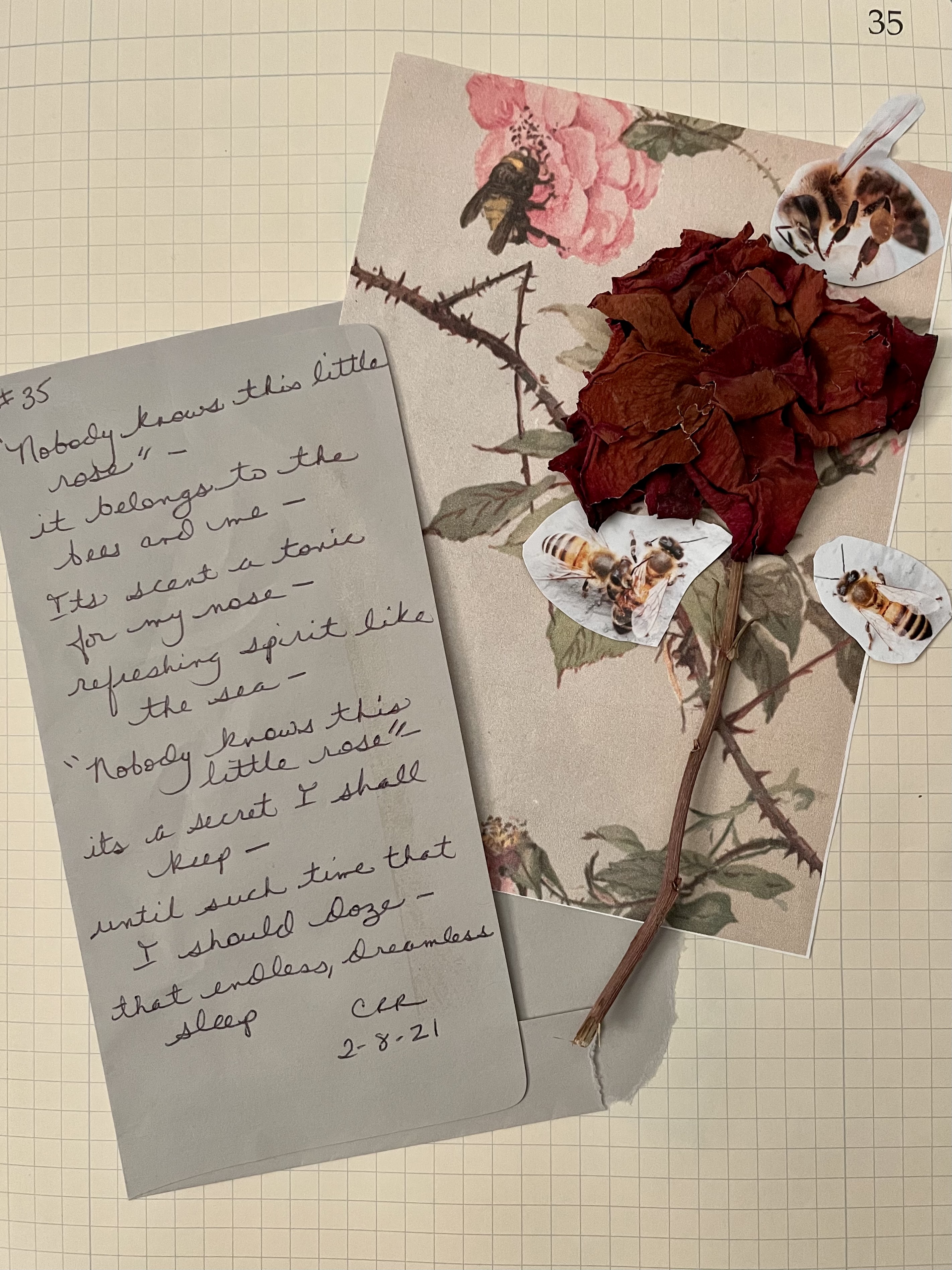
According to the Emily Dickinson Archive, there are 280 instances of bees in poems written by her. There is plenty of analysis out there regarding her personification of bees and flowers etc. and how it speaks of gender conventions, religion and eroticism, but that’s not what this blog is about. It’s widely accepted that she loved nature and spent quite a lot of time by herself in it, thus why so many of her poems contain references to the natural world. Emily no doubt knew of the bee’s importance in contributing to biodiversity, creating a food source, and as pollinators facilitating wild plant growth. Bees are also said to pollinate one-third of the global food supply, more than 90 different agricultural crops.
Like Emily, I find great beauty and solace in nature. It has many valuable lessons and secrets to teach us if we take the time to observe the cycles, habits, and behaviors of other living things. One might surmise that Emily preferred the natural world over human beings, especially toward the end of her life when she became more reclusive. I submit that she sincerely appreciated the contributions of the natural world to the beauty of our planet and took the time to write about it.
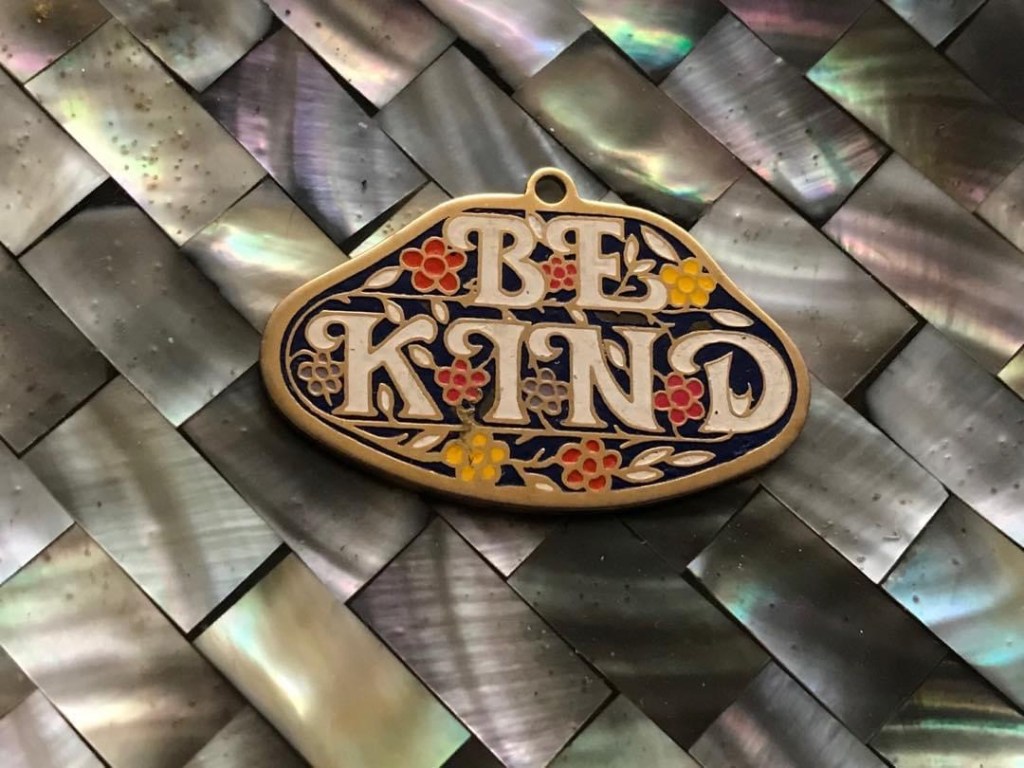
This photo came up as a serendipitous Facebook memory this morning. Serendipitous because I just finished a poem about kindness yesterday, with the intent of posting it today. This “Be Kind” pendant is one of the few relics I have from my teenage years. Three years ago I found it in a box of memories. Although it’s nearly 50 years old, its message is timeless. I remember buying it at The Infinite Mushroom, a really cool head shop in Orlando in the early 70s. It was where every teen went to get their black light posters, ultra-cool clothes/accessories, and of course the other things that made it a “head shop”.
Emily often sent poems as part of her letters or accompanying them, to family, friends and acquaintances. She wrote the first line of this poem in a letter to Samuel Bowles in August of 1858. Bowles was the Editor-In-Chief of the Springfield Republican newspaper. Over the years he became Emily’s confidant and would receive 40 poems in letters from her, but publish none of them. Seven of her poems were published in his paper during her lifetime, but the specifics of how they came to be published remain unknown.
Despite all the goodness and good people that are out there making the world a kinder place every day, today’s Carol and Emily poem recognizes the still ever present need for a “Kindness Revolution”. Because you can never have too much kindness or spread too much love.
In the Spring of 1862, Emily Dickinson wrote the words “The heart wants what it wants, or else it does not care” in a letter to her friend Mary Bowles. She was offering Mary consolation, as her husband was going abroad for an extended period of time. At the same time, Emily admits that there is really no way to console her friend, because the heart has a mind of its own and the friend’s husband will still be missed, even as she is assured of his return.
Throughout Emily’s 55 years she was never known to have a romantic relationship, but the letters she left behind suggest she did have several intimate relationships, which she “tells it slant” about in her poetry. “Tell it slant” was a phrase used in another poem of hers, whose first line is “Tell all the truth, but tell it slant” which seemed to suggest that rather than shocking a person with the whole big truth at once, one should start from a circuit around it and gradually reveal the whole picture. The phrase “tell it slant” has come to be associated with Dickinson and each year the Emily Dickinson Museum in Amherst holds a Tell It Slant poetry festival and gives a Tell It Slant award.
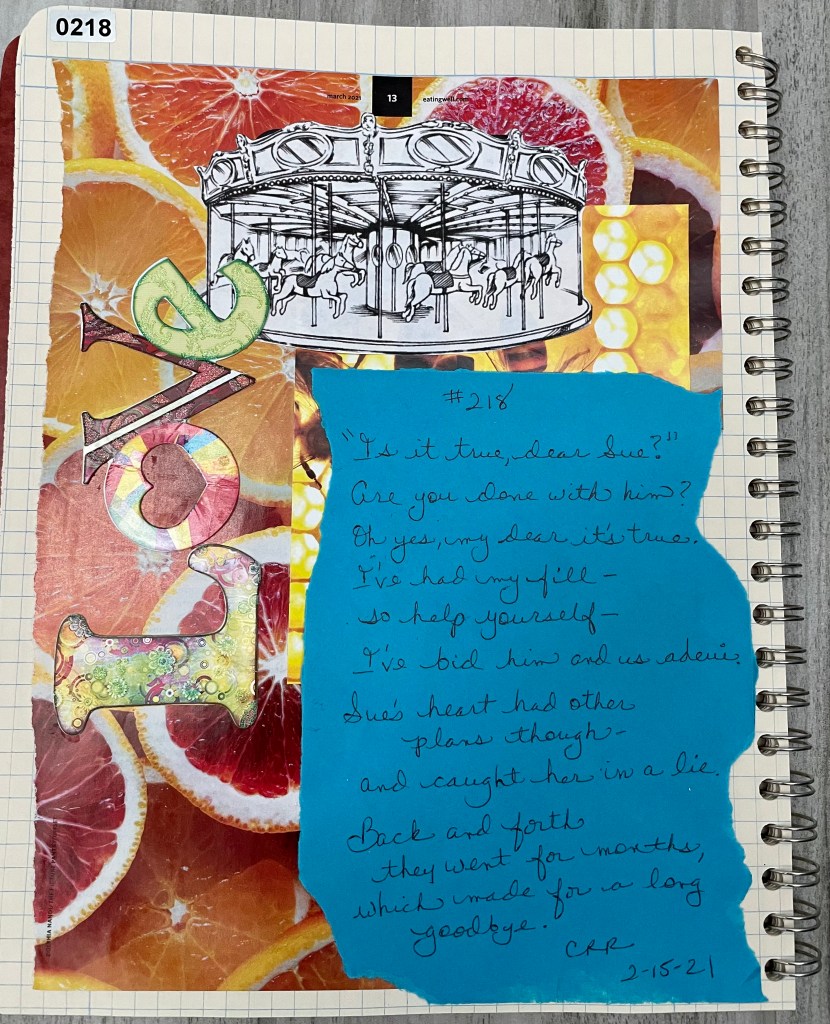
In researching analysis of “Is it true dear Sue?”, most agree that those words were directed to her lifelong friend, love and sister-in-law, Susan Huntington Gilbert with regards to Emily’s brother Austin, whom Sue would go on to marry. Emily is questioning whether or not there are now two who love her, and competing for her love.
Todays Carol and Emily poem is based on a real experience that I had at the end of a long term relationship, one that ended slowly, and slant, but led us both to where we belonged, with another.
“The world is round, and the place which may seem like the end, may also be the beginning.”
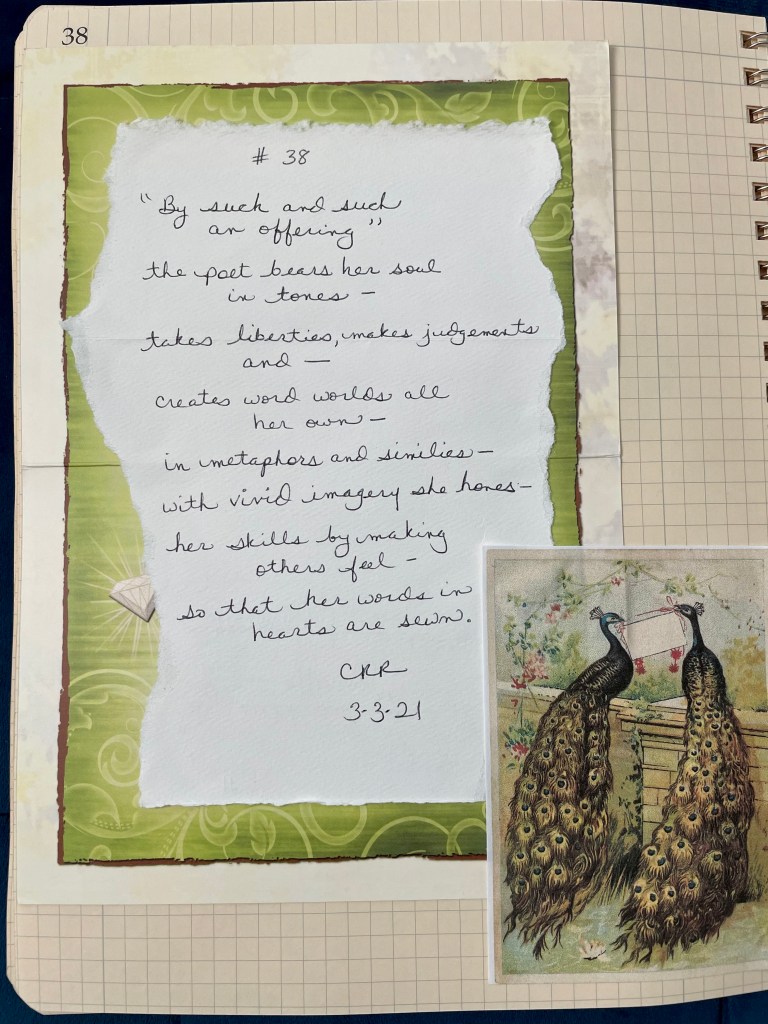
Remember that one day of the week in Kindergarten? The day you were allowed to bring that special object of yours and tell the entire class all about it and why it was special to you? That’s what writers do every day, whether they are poets or novelists, screenwriters or essayists, they tell stories and paint pictures with their words. Today happens to be International Writer’s Day, a day established to recognize and honor those who chose a lifetime of show and tell.
There’s a so called Golden Rule of Writing that says you should show instead of tell, by using sensory details that allow the reader to be immersed in the scene or emotion, as if they were there, experiencing the action or sensing a character’s personality traits. Emily was quite adept at explaining abstract concepts using imagery and concrete objects that readers could easily relate to. In other words, she was really good at show and tell. When I read her work, I get the feeling that like me, she viewed words as almost sacred conveyors of emotions, thoughts and stories. The following quote illustrates her understanding of the power they hold.
“I know nothing in the world that has as much power as a word. Sometimes I write one, and I look at it until it begins to shine.”
Emily Dickinson
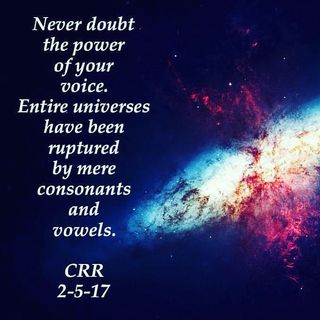
My quote about the power of words.
Today’s Carol and Emily poem is about words, writing, and the hope that in sharing our words, we writers touch hearts. And perhaps, some of our words even shine.
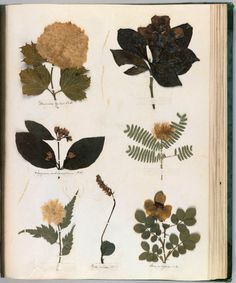
An avid observer, Emily Dickinson began showing an interest in botany when she was 9 years old. She loved to help her mother in the family garden, which contained quite an extensive variety of flowers. When she went away to school at Mt. Holyoke, she was encouraged by the principal and founder of the school to create an herbarium. Emily went on to collect, press and classify 424 flowers from the Amherst region. The leather bound album she pressed and posted them in survived and has been digitized by Houghton Library at Harvard University. You can access it here Harvard Mirador Viewer. You can also tour the Homestead gardens at Dickinson’s family home in Amherst, MA. Although I haven’t yet been, it’s definitely on my “post Covid – when we can finally travel safely again” list of places to visit.
Emily often sent flowers with her letters to friends and family and gifted them on birthdays and occasion of deaths and illnesses. A large number of her poems contain references to them. According to Judith Farr, author of The Gardens of Emily Dickinson, one-third of Dickinson’s poems and half of her letters mention flowers, with the rose taking first place for most mentions. Pictured below is a page from Emily’s Herbarium and today’s Carol and Emily poem, which tells of one particular rosebush that she kept as a secret for herself and the bees.
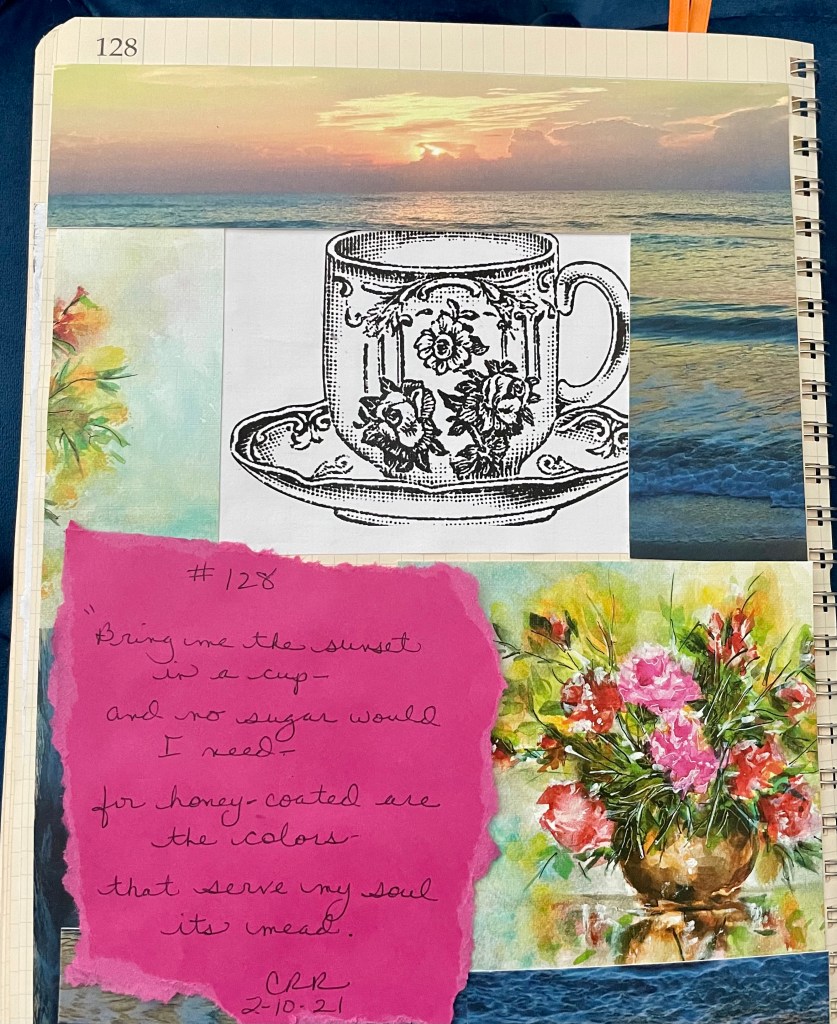
I’ll never stop being the girl who drags people outside to watch a sunrise or sunset. The power, magic and majesty of each one fill me with the awe of a child, still. My phone is filled with hundreds of photos of them that my husband believes all look alike. But I can see the difference in every one, remembering the time and place each was taken, who I was with, what the air smelled like, and how gravity held me in stillness as I breathed it all in.
In her poem beginning with this line, Emily wonders about many things. It’s about the many wonders of nature, who created them, and of course her immense pleasure in the spectacle of the sun setting. I share in that pleasure. It fills my soul. If even if for a short time, I’m filled with peace and the knowledge that there is always beauty to be found. Life goes on and begins again, every morning, giving new hope to us all.
*When trying to find words rhyming with need, I learned that “mead” is honey wine, sometimes flavored with fruits, spices and grains. The word fits perfectly.
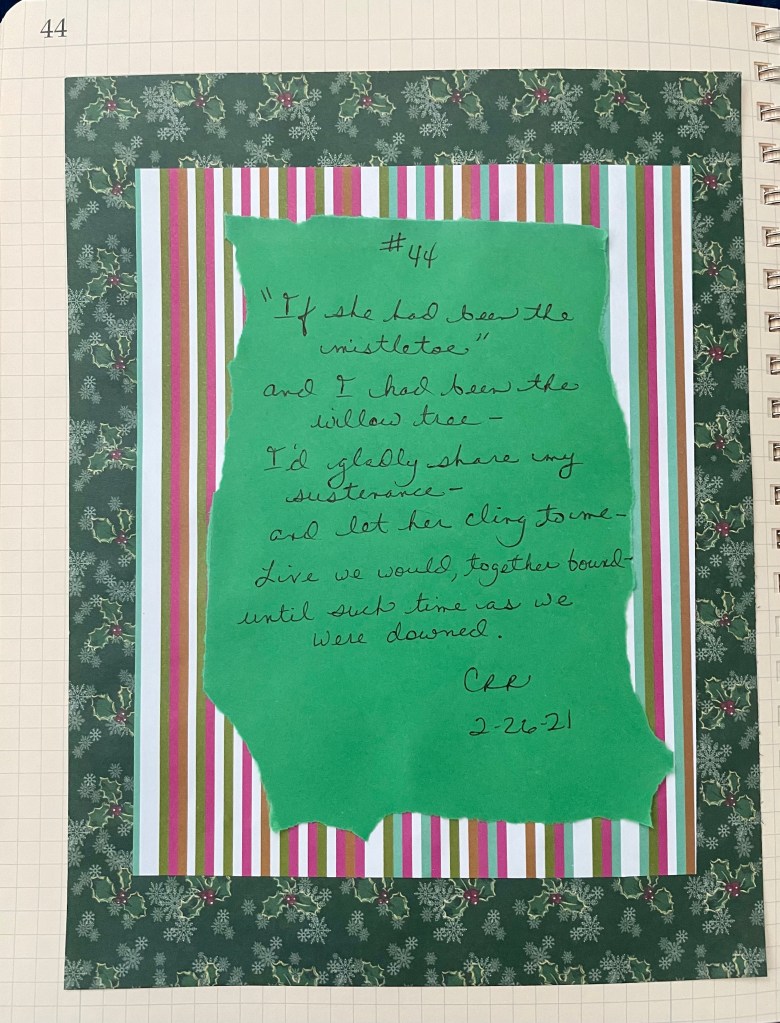
I know it’s not December or Christmastime, but this is the one I chose to share today. Most of us know the tradition of kissing under the mistletoe at Christmas, but if you’re like me, you don’t know much more than that about it. In researching it this morning I learned quiet a bit. Beginning with the fact that mistletoe is a hemiparasite. Hemiparasites can live off of another plant, but are also capable of living on their own and making their own chlorophyll through photosynthesis. According to Britannica.com, mistletoe also has a storied past in Druid legends, where it is said to have been used in ceremonies of sacrifice and was also believed to have medicinal qualities.
In the 1800’s people corresponded by letter, an act which today we find delightfully surprising because so few do it. Emily was known to frequently send poems to friends and family in her letters to them. She sent her “Mistletoe” poem to her friend Samuel Bowles, the editor-in-chief of the Springfield Republican newspaper and is thought to have personified the rose as herself. I chose to place her in the role of the tree and profess her willingness to let another share herself, something I think she’d willingly submit to in the name of the deep soulful love she seems to have felt for several people, both male and female, in her life.
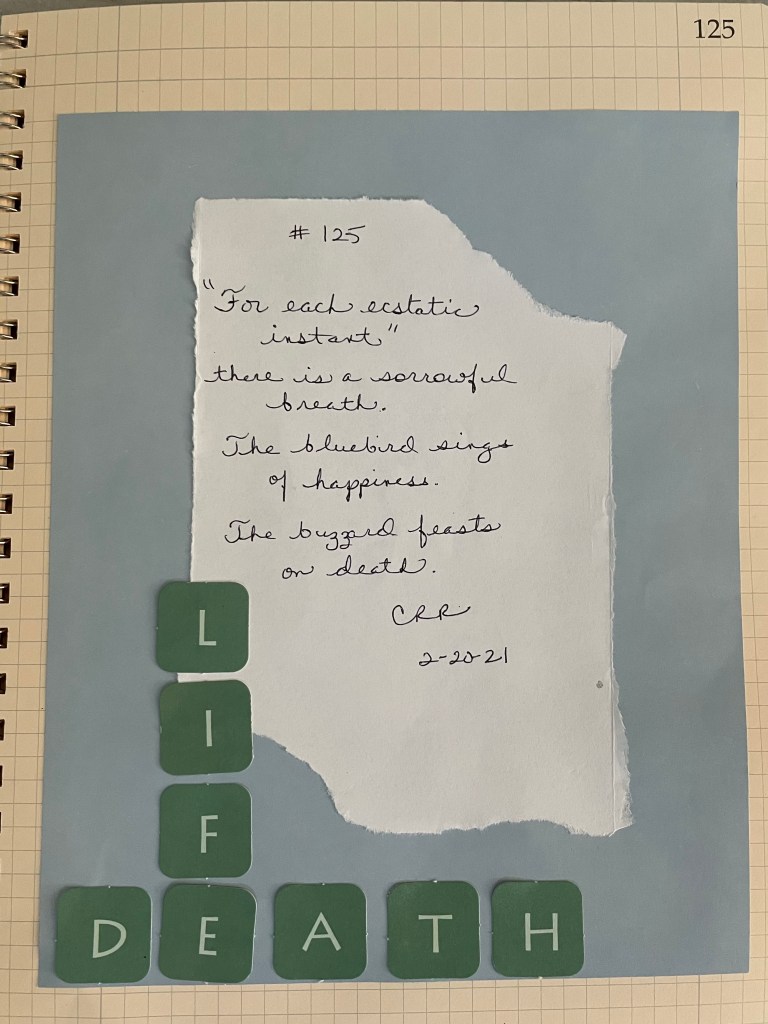
If you read enough of her work, you’ll soon realize that death is a recurring theme in Emily Dickinson’s poems. Some have found it morbid, but others appreciate the innate curiosity that drew her into philosophizing and speculating about death and an afterlife. Biographers have noted that she grew up living next to a cemetery, which may have started her thinking about the subject. Throughout her life, she was an avid observer of nature and as her poetry reveals, a deep thinker. As a homebody, she certainly had time on her hands to engage in both of those activities.
I don’t write about death a lot, but I will confess to having a preoccupation with True Crime/Murder. I’m a Dateline junkie and have just discovered a great true crime podcast to listen to while I work on the cutting and pasting part of this project. Somehow, I think if Emily were alive now, she’d share my attraction. I haven’t spent a lot of time trying to analyze why I’m drawn to that kind of thing, as opposed to the Hallmark movie genre, but a quick Google of the question tells us that people like me are drawn to the genre because its speaks to the dichotomies of life (good-vs-evil, etc.) and like a haunted house or going to Halloween Horror Nights, we get to experience fear in a safe setting. Makes sense to me.
Emily often wrote about the dichotomies of life and today’s Carol and Emily poem does that too with ecstasy and sorrow, breath and death….
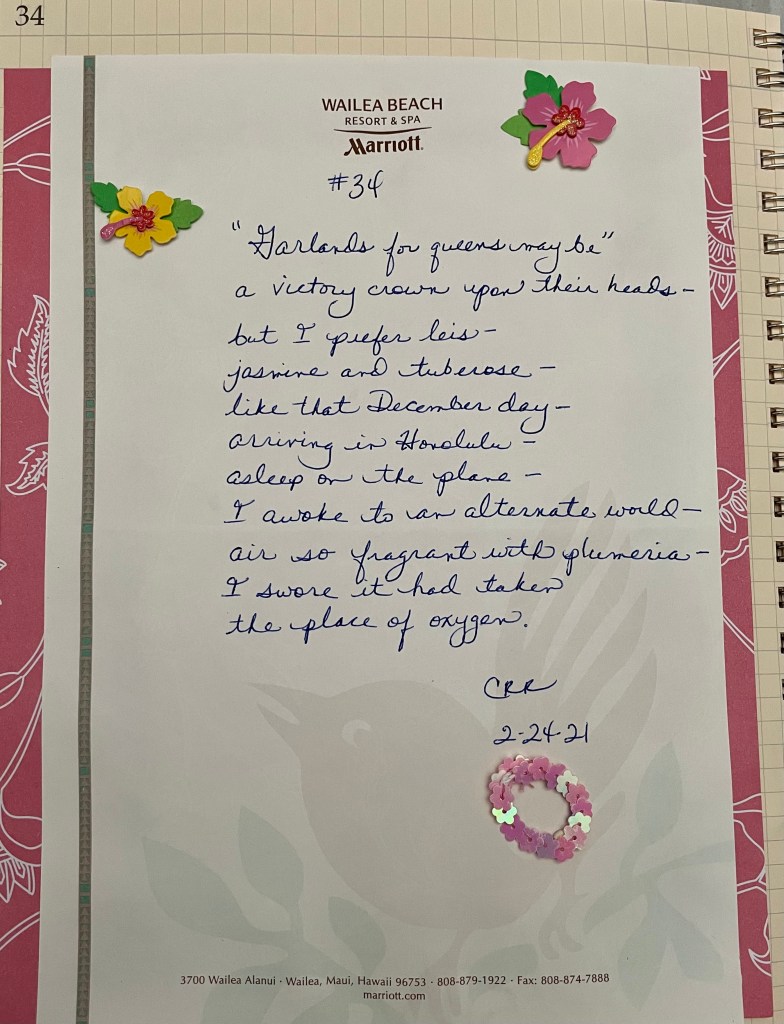
While it’s true that Emily Dickinson is known as a recluse who hardly ever left her parent’s home in Amherst, Massachusetts, she did in fact have several occasions to travel during her lifetime. *At 17, she was enrolled in Mount Holyoke Female Seminary in South Hadley, Massachusetts, spending a year there. Although she professed in letters to love the entire experience, her longing for home was greater. With her father being a Senator in the Whig party, in 1855, when she was 25, she and her sister Lavinia had the opportunity to visit Washington, DC and Philadelphia. Beyond those two trips, it’s believed that Emily never ventured out into the larger world and is said to have been quite content with her life in Amherst, where she never seemed to run out of inspiration.
Fast forward 166 years and that’s pretty close to how long it feels like it’s been since the pandemic brought our travel plans to a halt. Travel is “our thing”. My husband and I love to travel to new places and experience new cultures, foods, and vistas. I retired from teaching in June of 2019 and in the 9 months before the pandemic hit , we were lucky enough to take 3 trips and visit 10 different countries. It literally feels like eons ago, but the memories remain. The sights, smells and sounds live on forever in our minds, like those of our honeymoon 15 years ago in Hawaii, where the air is truly rare. Today’s Carol and Emily project remembers that.
It’s said that before her death, Emily Dickinson made her sister Lavinia promise to burn all her poems and letters. While she did burn some of her letters, Lavinia broke the promise and chose not to destroy the almost 1800 poems that she discovered. How lucky we are that she made that choice and went on with the help of others to see that they were published. Dickinson biographers agree that Emily made very few efforts to be published before her death. After being told that her style was untraditional of the time and just didn’t fit, she may have been discouraged, but even if that were true, it certainly didn’t stop her from writing prolifically.
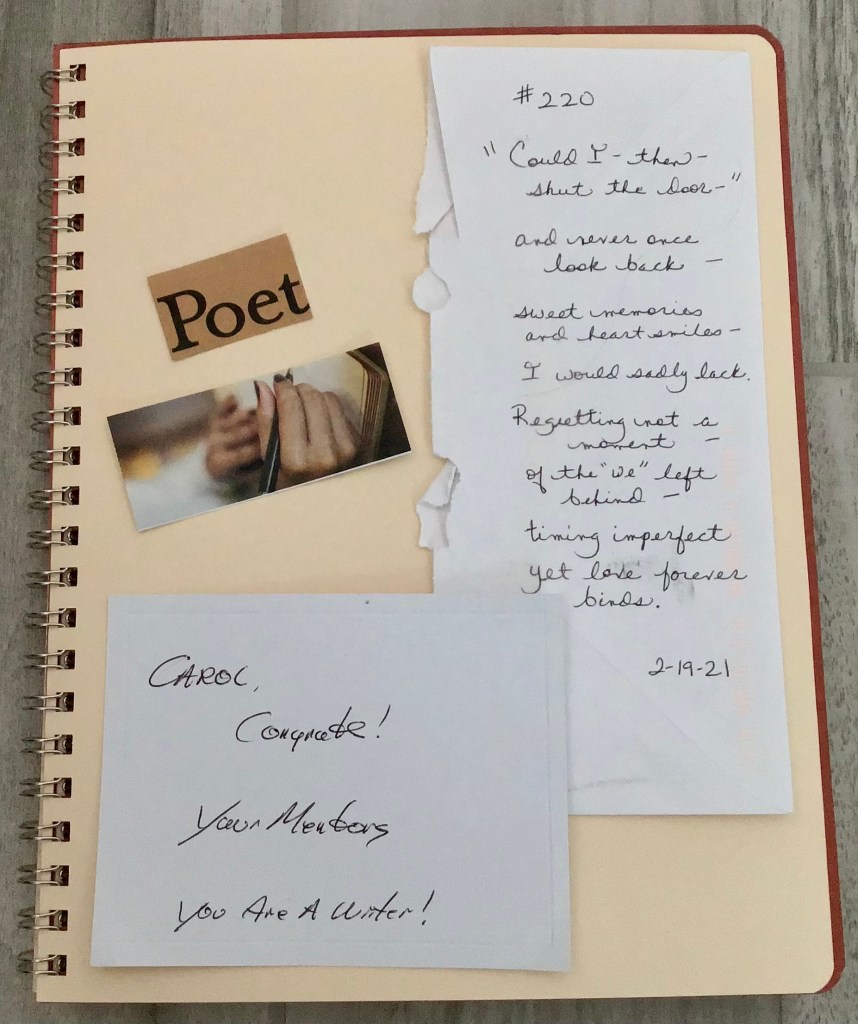
Could she have had “imposter syndrome”? That evil green eyed monster of a virus that attacks our confidence and tells us that we aren’t good enough at whatever it is that we want to do? I had a serious bout with that this morning as I was trying to choose which Carol and Emily poem to share on today’s post. I probably read 20 different poems and found something wrong with every one of them, even the one I posted below. I know I’m my own harshest critic and the battle not to be is constant and real.
Above my desk , I keep the card I received with my award certificate from the Story Summit last year. It has 4 all important words on it. “You are a writer!” It’s there to remind me on days like this, when I doubt myself, that I really am.
No matter what field or life stage you’re in, the imposter syndrome can slither its way into your brain. The trick is to surround yourself with encouragers and encouragements in whatever form works for you. Emily apparently had few encouragers, but we have to believe that she found encouragements and inspiration everywhere in the rich microcosm of her secluded life. Her 1775 poems tell us that.


 The Carol and Emily Project